 Zero Pest
Flats £190 | Houses £220
How Do You Know If You Have Ants in Greenwich?
Nobody needs help identifying an ant. The questions worth answering are different: is there a nest, where is it, is it yours, and does this actually…
Read the guide →Ant Control advice
A reference rather than a checklist. Every sign an ant colony gives away, the two species that behave differently, and the three insects people bring to us thinking they are ants.
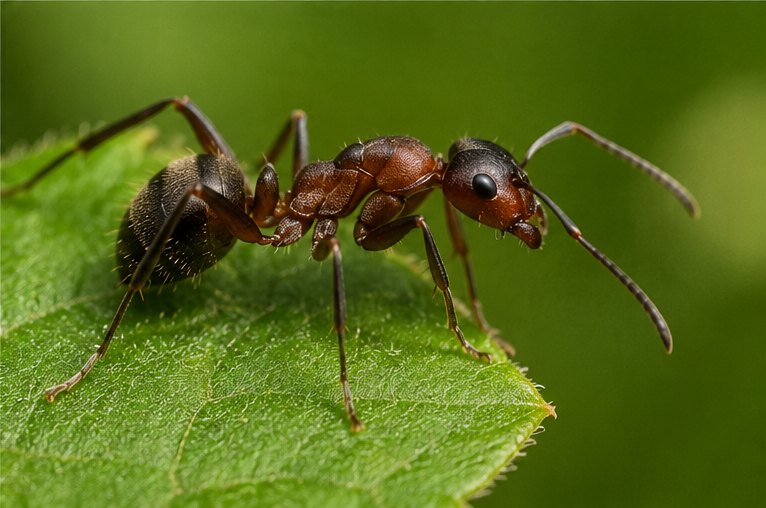
What to look for: a consistent line of ants moving in both directions along the same route, typically hugging an edge - a skirting, a worktop join, the line where a wall meets a floor, the frame of a door.
What it tells you: more than anything else. Ants lay a chemical trail between food and nest and follow it faithfully, so the line is a map. Follow it to where it leaves the building and you are within a metre or two of the nest.
What it rules out: individual ants wandering with no pattern are foragers exploring, and may have nothing to do with your property. The consistency is the signal, not the number.
What to look for: small piles of fine, loose, crumbly soil pushed up between paving slabs, at the edge of a path, on a doorstep, at the base of a wall or through a crack in concrete. Often fresher and finer than surrounding soil.
What it tells you: the nest is directly beneath, and it is active. This is the clearest external sign there is, and pointing at it when we arrive saves a great deal of time.
What it rules out: worm casts are larger, wetter and more granular. Mole activity is on an entirely different scale.
What to look for: ants prefer dry, workable, well-drained ground with something warm above it. In practice that means:
What to look for: dark brown to black, the familiar ant of British gardens. Nests outdoors in soil and under hard surfaces, comes indoors to forage, and is most active in warm weather.
What it tells you: that this is the ordinary version of the job - an outdoor colony with a route in, treatable by baiting the trail so the workers carry it home.
What to look for: much smaller, yellowish to light brown, sometimes almost translucent. Found indoors all year rather than seasonally, in heated buildings - around warm pipework, in wall voids and service runs, often in blocks of flats and other buildings with continuous heat.
What it tells you: that the standard approach is the wrong one. Chemical disturbance can cause a pharaoh ant colony to split and relocate into several new nests, so identification matters here in a way it does not with a garden ant.
What it rules out: if the ants are the familiar dark garden ant, active in summer, with a trail leading outside, this is not what you have.
What to look for: winged ants emerging in numbers over a short period on a warm day, often across a whole neighbourhood at once. Larger females and smaller males.
What it tells you: mature nests nearby releasing new queens and males. That is all. It is not an infestation of the building they emerged beside, and it ends within days.
What it does not tell you: where the nest is with any precision, or whether it is on your property. Useful only as confirmation that a mature colony is somewhere close.
What to look for: a two-way stream converging on a spillage, a fruit bowl, a bin, pet food or an open packet.
What it tells you: the food source, which is worth removing - not because it clears the colony, but because it stops the colony being rewarded while the treatment works.
The one measurement worth taking. Note the time of day the trail is busiest and roughly how long it has been running. A trail that has been there for weeks means an established colony; one that appeared this morning after somebody dropped something may resolve itself.
The narrow waist and the elbowed antennae are the two features worth learning. Between them they settle almost every ant-or-not question.
Mostly it does not matter which species you have. Where it does - a very small pale ant indoors all year in a heated block - a usable photograph is the difference between the right treatment and the wrong one.
If you find a dead one, keep it in a clear bag rather than binning it. A specimen beats a photograph, and both beat a description over the phone.
Excavated material from a nest directly beneath. It is the clearest external sign there is, and pointing at it when we arrive saves a great deal of time.
In dry, well-drained ground with something warm above it - under paving, beneath a doorstep, against a sunny wall base, under decking or a shed. Occasionally in a cavity wall or under a floor, which produces year-round indoor activity.
Garden ants are the familiar dark ant, nesting outdoors and foraging indoors in warm weather. Pharaoh ants are much smaller and yellowish, nest inside heated buildings, and are active all year. The treatment differs, so identification matters.
The narrow waist and the elbowed antennae. Between them they settle almost every ant-or-not question - beetles lack both, and springtails jump.
No. Follow it to where it leaves the building. It may lead to a nest under your own paving, or over a boundary into a neighbouring garden, and that changes what a realistic result looks like.
The rest of the ants advice centre, and the service page it all links back to: Ant Control Greenwich.
Nobody needs help identifying an ant. The questions worth answering are different: is there a nest, where is it, is it yours, and does this actually…
Read the guide →Almost everyone tries the same thing first, and it is the one approach that can leave you worse off than before. Here is what is actually happening,…
Read the guide →Ant treatment is £190 for a flat and £220 for a house. That house figure is the odd one out on this site, and the reason it is lower says something…
Read the guide →Ants return for four reasons, and one of them is unusual: it is caused by whatever was done last time. Working out which applies is what stops you…
Read the guide →Tell us what you have seen and where in the property you found it, and we will confirm the service and the price before anything is booked.
Flats £190 | Houses £220. Call 020 3369 0124, send the enquiry form or message us on WhatsApp.