 Zero Pest
From £180
How Do You Know If You Have Carpet Beetles in Greenwich?
Carpet beetle announces itself in three ways, and most people notice the least useful one first. Here is what actually confirms it - and…
Read the guide →Pest Control Greenwich
Carpet beetle damage is small, clean holes rather than grazed patches, and the source is very often somewhere nobody has looked - a bird's nest in the eaves, an old wool item in a loft, a forgotten woollen coat at the back of a wardrobe. Treating the carpet without finding that source is why the holes keep appearing.
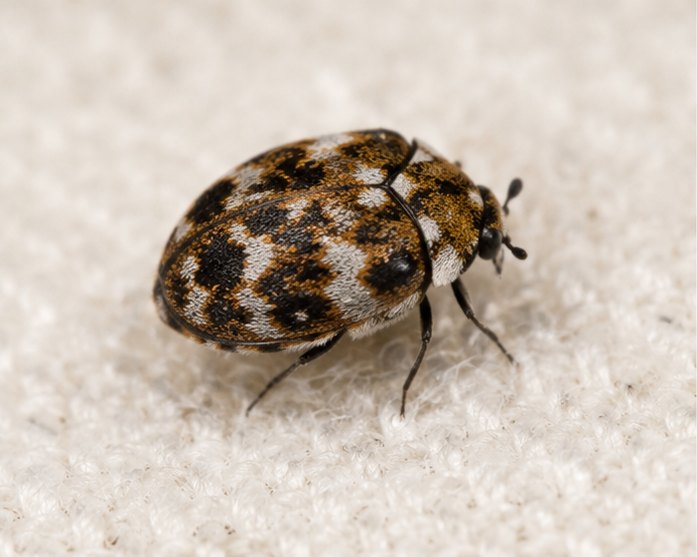
This is the part of the job that distinguishes carpet beetle from every other fabric pest. The larvae feed on keratin, and one of the richest sources of it in a house is not the carpet at all - it is an old bird's nest in the eaves, a loft or a disused chimney, full of feathers and other debris. A nest can support a population for years, and the larvae then work their way down into the rooms below.
So when damage keeps returning after the floor has been treated, the honest answer is usually that the source was never on the floor. The same applies to an old wool blanket, a sheepskin, a feather pillow or a forgotten rug stored in a loft - and to bees' or wasps' nests left in a roof void, which leave behind exactly the sort of debris carpet beetle larvae will live on.
If the holes come back after the carpet was treated, the question is not what was used on the carpet. It is what is in the loft.
Zero Pest Greenwich publishes its standard treatment prices, so you can see the cost before you contact anybody.
| Carpet Beetle Control in Greenwich | Published price |
|---|---|
| First room treated | £180 |
| Each additional room | £60 |
Carpet beetle treatment is priced by the rooms that need treating, with the first room carrying the assessment and each additional room at the lower rate. Rooms are confirmed on site.
Where the source turns out to be a nest in a roof void or eaves, dealing with it may involve access work that is a roofing job rather than a pest control one. We will tell you that plainly rather than treating the carpet repeatedly.
The survey covers the damaged areas and then goes looking for the source: loft space where accessible, eaves, airing cupboards, wardrobes, drawers, stored textiles and any old nesting material. Finding it is what makes the treatment last, and where it is beyond what we can safely reach - a nest in a sealed roofline, for instance - we will say so and describe what needs doing.
Treatment is applied to floor perimeters, beneath furniture, along skirting lines and to the affected storage areas. Where an accessible source such as old nesting material is found, removing it does more for the outcome than any amount of product applied to the carpet below it.
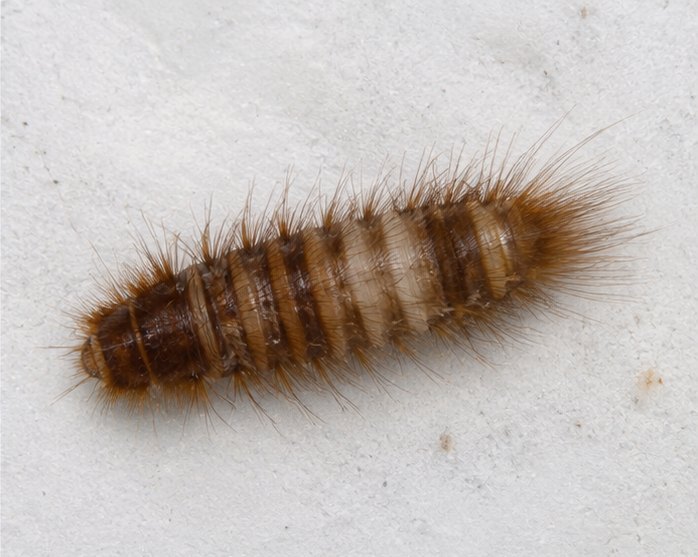
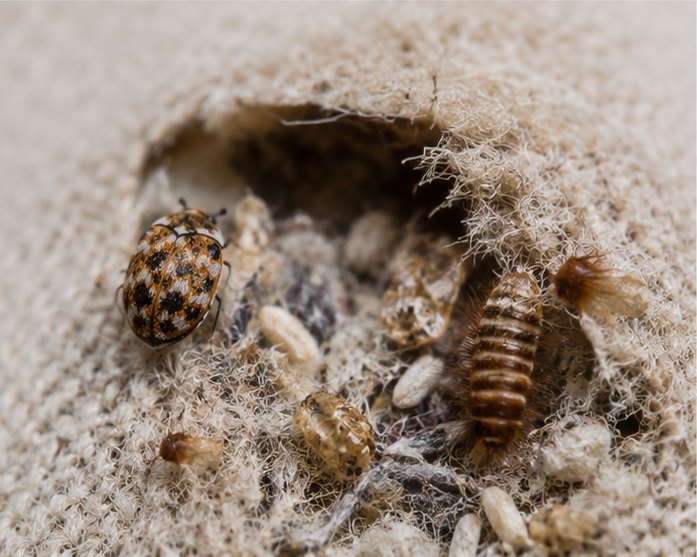
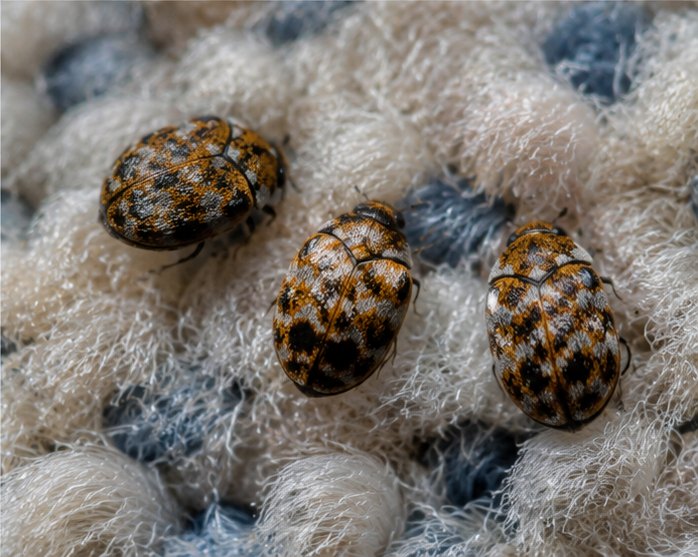
The two are treated differently and confusing them costs time. Carpet beetle leaves discrete holes and hairy larvae with shed skins, and its adults are small mottled beetles found at windows. Carpet moth leaves grazed and thinning areas with silken tubes in the pile, and its adults are small weak-flying moths seen low down near skirtings. If you have found a beetle on a windowsill and holes in a wool jumper, this is the right page.
The same service, described for the three situations it is most often booked in.
Tell us where the holes are, whether you have found larvae or shed skins, and whether there is loft access above the affected room.
Recurring fabric damage in the same property is usually a source problem rather than a tenant problem, and the report will say where the source was found.
Wool carpet in quiet areas and stored textiles. Older buildings with eaves and roof voids are the usual candidates.
Carpet Beetle Control has its own page for every area we cover, each with the same published price and the detail that actually applies to that area’s buildings.
Five guides for this service are being written for the Zero Pest advice centre.
Carpet beetle announces itself in three ways, and most people notice the least useful one first. Here is what actually confirms it - and…
Read the guide →Carpet beetle is the one fabric pest where treating the damaged room is only half the work. The other half is finding what has been feeding…
Read the guide →Carpet beetle treatment is £180 for the first room and £60 for each additional one. The published price covers the rooms. Whether it covers…
Read the guide →A reference rather than a checklist. Every stage of the insect, every mark it leaves, and a side-by-side comparison with carpet moth -…
Read the guide →Of every pest on this site, carpet beetle is the one where recurrence has the most predictable cause - and it is almost never the…
Read the guide →Carpet beetle leaves small, clean, sharply defined holes. Carpet moth grazes an area, leaving thinning or bare patches with silken tubes in the pile. The larvae look completely different too - bristly and banded for beetle, pale and grub-like for moth.
Almost certainly carpet beetle larvae, often called woolly bears. They shed their skins as they grow, and the empty skins are frequently found before the larvae are.
Usually because the source has not been found. Old bird nesting material in a loft, eaves or chimney is a classic reservoir, as are stored wool or feather items. Treating the floor beneath a source will not outlast the source.
No. They damage natural fibres. Some people react to contact with the larval hairs, but the insect does not bite or feed on people.
It is priced by room - a set figure for the first room and a lower rate for each additional room, both published on this page.
Greenwich, Blackheath, Woolwich, Eltham, Charlton, Plumstead and Abbey Wood.
Yes. Where the source is in a roof void or eaves it is usually a matter for the landlord or freeholder rather than the tenant, and the report will make that clear.
Call the office or send the enquiry form, and tell us where the damage is, what you have found, and whether there is loft access above.
Every service has its own page with its own published price.
Tell us what you have seen, where in the property you found it and whether it is a house, a flat or commercial premises. We will confirm the service and the price before anything is booked.
£180 for the first room and £60 for each additional room. Call 020 3369 0124, send the enquiry form or message us on WhatsApp.