 Zero Pest
From £180
How Do You Know If You Have Carpet Beetles in Greenwich?
Carpet beetle announces itself in three ways, and most people notice the least useful one first. Here is what actually confirms it - and why the…
Read the guide →Carpet Beetle Control advice
Of every pest on this site, carpet beetle is the one where recurrence has the most predictable cause - and it is almost never the treatment. It is a reservoir somebody has not found yet.
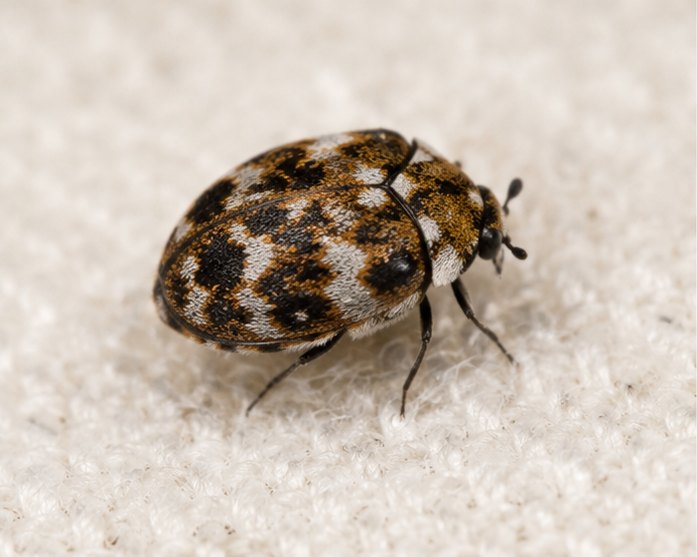
The floor is treated. The damage stops. Six months or a year later, small clean holes start appearing again - sometimes in the same room, often in a different one.
That pattern is not a failed treatment and repeating the floor treatment will reproduce it. It is a supply line, and the supply is coming from somewhere that was never part of the job.
If the holes come back after the carpet was treated, the question is not what was used on the carpet.
The single most common answer, by a wide margin.
Old bird nesting material in the eaves, a roof void or a disused chimney is full of feathers, and feathers are keratin. A nest like that can support a carpet beetle population for years, with larvae working downward into the rooms below and adults emerging each spring.
Old wasp and bee nests left in a roof space do the same thing for the same reason - what is left behind is exactly the kind of debris the larvae live on.
The tells:
The domestic version of the same thing, and easier to fix.
Any of these can carry a population indefinitely while the treated floor stays clean, then reseed it. The fix is to find and deal with the item, not to treat the room again.
The complication that makes some cases genuinely hard.
Runs of terraced housing can have continuous or shared eaves and roof spaces. A nest four doors along, in a void that connects, will keep supplying a population that appears in your bedroom. Treating your side of a shared void is a temporary result.
Where that is what the evidence suggests, a report describing what was found and where is worth more than another treatment - it is what a neighbour, a landlord or a freeholder needs in order to act.
The honest version, and it is worth stating clearly.
Sometimes the survey identifies where the material is and it sits behind a sealed roofline or in an eaves space with no safe access. That is roofing work rather than pest control, and if it does not get done, the problem returns regardless of how well the rooms were treated.
We will always say when we think that is the situation. What we will not do is keep treating the floor annually and describe it as maintenance.
The straightforward treatment-side cause. Larvae continue emerging for a period after treatment, and cleaning the treated perimeter or the treated cupboards inside the window we specify removes the treatment before it has dealt with them.
Temporary instruction, real consequence. After the stated period, regular vacuuming of the edges is exactly what you want to be doing.
What to tell us if it has come back. Which room the new damage is in and whether it is the treated one, whether there is loft access and what is in it, whether there has ever been a bird nest in the roof, and whether the edges were cleaned during the specified period. Those four answers identify the cause almost every time.
Done in that order it does not come back. Done in reverse order - treat the floor, hope, treat the floor again - it always does.
Adults emerge and head for the light in spring, which makes it the one time of year when a developing problem announces itself. Fifteen minutes then is worth more than any amount of looking in November.
Beetles at a window are not damage and they are not an emergency. They are a signal, and acting on that signal in spring is how you avoid finding the holes in December.
Because the source was almost certainly not the carpet. Old bird nesting material in the eaves, roof void or a disused chimney can feed a population for years while the damage appears in the rooms below.
Often yes - it points at a reservoir above the ceiling rather than in the floor, particularly if the new room is upstairs or under the eaves.
We will search everywhere accessible and describe where we believe the material is if it is not. Reaching a sealed eaves space is roofing work, and a roofer will quote it - but it is what ends the cycle.
In a terrace with a continuous or shared roof void, yes. Treating your side of a shared void is a temporary result, and a report saying where the material is will be what a neighbour, landlord or freeholder needs to act on.
No. Carpet beetle needs animal fibre and undisturbed conditions, not mess. Immaculate homes with good wool carpet and a bird's nest in the eaves are close to ideal for it.
The rest of the carpet beetles advice centre, and the service page it all links back to: Carpet Beetle Control Greenwich.
Carpet beetle announces itself in three ways, and most people notice the least useful one first. Here is what actually confirms it - and why the…
Read the guide →Carpet beetle is the one fabric pest where treating the damaged room is only half the work. The other half is finding what has been feeding the…
Read the guide →Carpet beetle treatment is £180 for the first room and £60 for each additional one. The published price covers the rooms. Whether it covers the whole…
Read the guide →A reference rather than a checklist. Every stage of the insect, every mark it leaves, and a side-by-side comparison with carpet moth - because that…
Read the guide →Tell us what you have seen and where in the property you found it, and we will confirm the service and the price before anything is booked.
£180 for the first room and £60 for each additional room. Call 020 3369 0124, send the enquiry form or message us on WhatsApp.