 Zero Pest
From £180
How Do You Know If You Have Carpet Beetles in Greenwich?
Carpet beetle announces itself in three ways, and most people notice the least useful one first. Here is what actually confirms it - and why the…
Read the guide →Carpet Beetle Control advice
A reference rather than a checklist. Every stage of the insect, every mark it leaves, and a side-by-side comparison with carpet moth - because that is the distinction that decides the treatment.
Worth putting first, because it is the question almost every enquiry needs answered.
| Carpet beetle | Carpet moth | |
|---|---|---|
| Damage | Small, clean, sharply defined holes | Grazed, thinning or bare patches |
| Larva | Short, stout, bristly, banded - 'woolly bear' | Smooth, pale, caterpillar-like |
| Larval trace | Pale hollow shed skins | Silken tubes the colour of the pile |
| Adult | Small mottled beetle, on windowsills in spring | Small buff moth, low down near skirtings |
| Usual source | Often a nest or stored item above the ceiling | Usually the undisturbed floor itself |
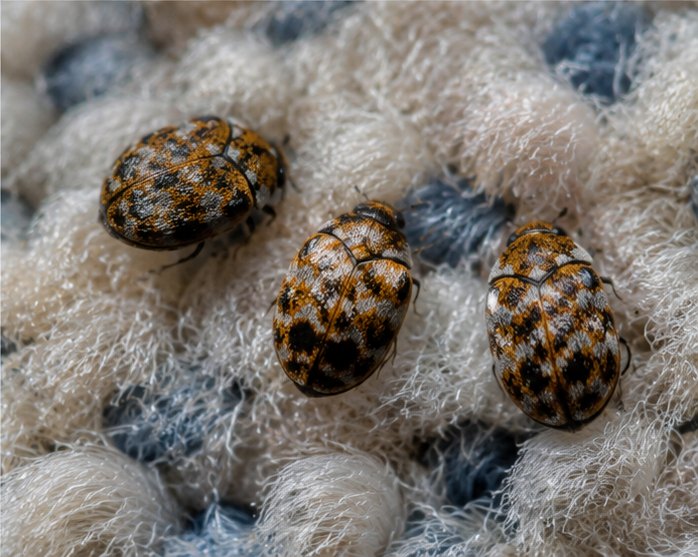
What to look for: small, rounded, hard-shelled and mottled - typically a pattern of pale and dark scales rather than a single colour. Considerably smaller than a ladybird.
Where: on windowsills, at windows, and around light. Adults feed on pollen and nectar outdoors and are drawn to the light when they emerge, which is why the windowsill is where people find them.
What it tells you: that larvae have completed development somewhere in that part of the property. The adults themselves cause no damage at all, so this is a locator rather than a problem.
What to look for: short and stout rather than long and worm-like, brownish, distinctly bristly, with visible bands across the body. Curls up when disturbed and moves slowly.
Where: at carpet edges, under furniture, beneath rugs, in drawers and wardrobes, in the airing cupboard, and in loft insulation near a nest or stored textiles.
What it tells you: the actual cause. Everything else on this page is a consequence of these.
What to look for: pale, hollow, bristly casings holding the shape of the larva. Light enough to be moved by a draught, so they collect in corners, along skirtings and in the bottom of drawers.
What it tells you: larvae have been growing here over a period, which means an established population rather than a recent arrival. They are frequently found before any larva is seen, and they are the sign people most often sweep up without recognising.
What to look for: small, clean, sharply defined holes. On carpet they may be scattered rather than concentrated. On clothing they look punched. The fibre around each hole is undamaged, which is the distinguishing feature.
Where: wool carpet at the edges and under furniture, wool clothing in storage, blankets, felt, sheepskin, and natural-fibre upholstery.
What it rules out: gradual thinning with no distinct holes is carpet moth. Damage confined to cotton or linen is neither - they feed on animal fibre.
What to look for: old bird nesting material in the eaves, a roof void or a disused chimney. Old wasp or bee nests in a roof space. Stored wool blankets, sheepskins, feather-filled items or rolled rugs that have been in a loft for years.
What it tells you: why the damage keeps returning after the floor has been treated. A nest full of feathers is one of the richest sources of keratin a building can hold, and the larvae work downward from it.
Why it belongs in an identification guide: because it is a sign, not just a cause. If you have loft access and there is old nesting material up there, that on its own substantially raises the likelihood that unexplained fabric damage below is carpet beetle rather than anything else.
Do not clear the loft out the day before a visit. Bagging up old material and carrying it down through the house is how a contained problem gets distributed through every room on the way. Leave it until it has been looked at.
Carpet beetle is one of the easiest pests to confirm remotely, so a good enquiry can settle identification before anybody visits.
Keep any specimen in a clear bag rather than binning it. A shed skin is as useful as a live larva and considerably easier to catch.
Small, rounded, hard-shelled and mottled with pale and dark scales - much smaller than a ladybird. Found at windows and on windowsills in spring, because adults head for the light.
Shed larval skins. They hold the shape of the larva, they are light enough to collect in corners and drawers, and they indicate a population that has been growing over a period rather than a recent arrival.
No. Adults feed on pollen and nectar outdoors. All the damage is done by the larvae, which is why finding beetles at a window means looking at the floor and the storage in that part of the property.
Carpet beetle punches small, clean, sharply defined holes with the surrounding fibre intact. Carpet moth grazes an area down into a thinning patch. That single distinction settles most enquiries.
Because old nesting material full of feathers is one of the richest sources of keratin a building can hold, and it can feed a population for years while the damage appears in the rooms below. It is the commonest reason this problem returns after a floor treatment.
The rest of the carpet beetles advice centre, and the service page it all links back to: Carpet Beetle Control Greenwich.
Carpet beetle announces itself in three ways, and most people notice the least useful one first. Here is what actually confirms it - and why the…
Read the guide →Carpet beetle is the one fabric pest where treating the damaged room is only half the work. The other half is finding what has been feeding the…
Read the guide →Carpet beetle treatment is £180 for the first room and £60 for each additional one. The published price covers the rooms. Whether it covers the whole…
Read the guide →Of every pest on this site, carpet beetle is the one where recurrence has the most predictable cause - and it is almost never the treatment. It is a…
Read the guide →Tell us what you have seen and where in the property you found it, and we will confirm the service and the price before anything is booked.
£180 for the first room and £60 for each additional room. Call 020 3369 0124, send the enquiry form or message us on WhatsApp.