 Zero Pest
From £180
How Do You Know If You Have Carpet Beetles in Greenwich?
Carpet beetle announces itself in three ways, and most people notice the least useful one first. Here is what actually confirms it - and why the…
Read the guide →Carpet Beetle Control advice
Carpet beetle treatment is £180 for the first room and £60 for each additional one. The published price covers the rooms. Whether it covers the whole problem depends on what is in your roof.
| What is being treated | Price |
|---|---|
| First room treated | £180 |
| Each additional room | £60 |
Most pest control pricing pages stop at the figure. On carpet beetle that would be leaving out the part that decides whether you pay once or repeatedly, so here it is.
Carpet beetle larvae feed on keratin, and one of the richest sources of it a building can hold is not the carpet at all. It is an old bird's nest in the eaves, a roof void or a disused chimney, full of feathers and other debris. A nest like that can support a population for years while the visible damage appears in the rooms below.
If the holes keep coming back after the carpet was treated, the question is not what was used on the carpet. It is what is in the roof.
Old wasp and bee nests left in a roof void do the same thing, and so do stored wool blankets, sheepskins, feather-filled items and rolled-up rugs that have been up there since somebody moved in.
Three outcomes, and it is worth knowing which one you are in before you book rather than after.
The most useful thing you can tell us at the enquiry. Whether you have loft access, and whether there has ever been a bird, wasp or bee nest in the roof. That single answer often predicts which of the three situations above you are in.
Carpet moth and carpet beetle are both £180 for the first room and £60 for each additional one, because the room work is genuinely comparable: treatment to floor perimeters, beneath furniture, along skirting lines and into affected storage.
The difference between the two jobs is the search that comes with beetle work - the loft, the eaves, the airing cupboard, the wardrobes and the stored textiles. That is included, and it is the part that makes the treatment last.
You can usually do this yourself, and it is worth doing because the treatment differs:
If you have found a small mottled beetle on a windowsill and clean holes in a wool jumper, this is the right page. Send a photograph with the enquiry if you are unsure - it costs nothing and it occasionally saves a wasted visit.
Where the same property produces fabric damage year after year, the answer is almost always a source rather than a tenant. Our report records where the source was found, which is generally what a landlord, an agent or a freeholder needs in order to deal with a roof void that is not the tenant's responsibility.
Since finding the source is what makes this treatment last, it is worth saying what that part of the visit looks like.
Where there is safe access, the loft is entered and inspected: the eaves runs at both ends, around any chimney breast, the area beneath any roof light or vent, and the insulation itself. What we are looking for is nesting material - a bird's nest is the classic, but old wasp and bee nests leave the same kind of debris - along with stored wool, sheepskin and feather-filled items that have been up there for years.
Where there is no safe access, or the space is a sealed eaves void, we say so rather than guessing. What we can do is describe where the evidence suggests the reservoir is, clearly enough for a roofer to quote opening it up.
Do not clear the loft out the day before. Bagging up old material and carrying it down through the house is how a contained problem gets distributed. Leave it until it has been looked at.
Usually because the source has not been found. Old bird nesting material in a loft, eaves or chimney is a classic reservoir, as are stored wool or feather items. Treating the floor beneath a source will not outlast the source.
Yes - the survey covers the loft where it is accessible, the eaves, airing cupboards, wardrobes and stored textiles. What is not included is roofing work to reach a nest behind a sealed roofline, which is a different trade.
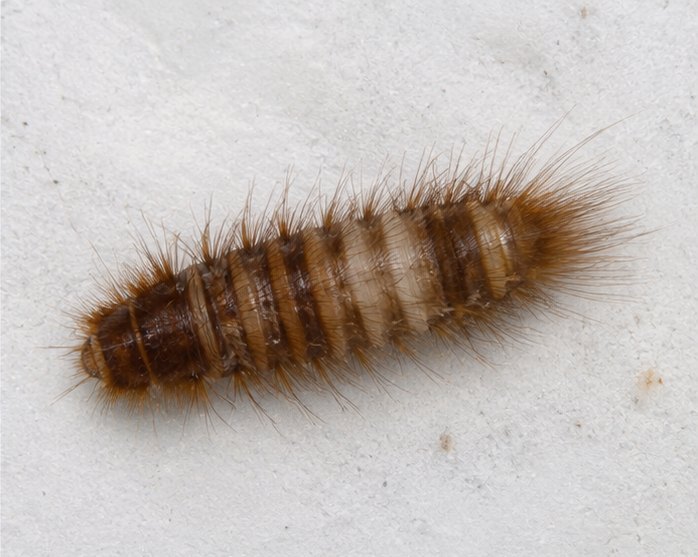
Almost certainly carpet beetle larvae, often called woolly bears. They shed pale skins as they grow, and the empty skins are frequently found before the larvae are.
No. They damage natural fibres. Some people react to contact with the larval hairs, but the insect does not bite or feed on people.
Beetle punches small clean holes; moth grazes an area into a thinning patch. The larvae look completely different too - bristly and banded for beetle, pale and grub-like for moth.
The rest of the carpet beetles advice centre, and the service page it all links back to: Carpet Beetle Control Greenwich.
Carpet beetle announces itself in three ways, and most people notice the least useful one first. Here is what actually confirms it - and why the…
Read the guide →Carpet beetle is the one fabric pest where treating the damaged room is only half the work. The other half is finding what has been feeding the…
Read the guide →A reference rather than a checklist. Every stage of the insect, every mark it leaves, and a side-by-side comparison with carpet moth - because that…
Read the guide →Of every pest on this site, carpet beetle is the one where recurrence has the most predictable cause - and it is almost never the treatment. It is a…
Read the guide →Tell us what you have seen and where in the property you found it, and we will confirm the service and the price before anything is booked.
£180 for the first room and £60 for each additional room. Call 020 3369 0124, send the enquiry form or message us on WhatsApp.