 Zero Pest
From £180
How to Get Rid of Carpet Beetles in a Greenwich Property
Carpet beetle is the one fabric pest where treating the damaged room is only half the work. The other half is finding what has been feeding the…
Read the guide →Carpet Beetle Control advice
Carpet beetle announces itself in three ways, and most people notice the least useful one first. Here is what actually confirms it - and why the answer is often above the ceiling rather than on the floor.
Any one of those is worth acting on. Two of them together is close to conclusive.
This is where carpet beetle separates cleanly from carpet moth, and you can do it yourself from a photograph.
Carpet beetle punches through. Small, round to irregular, clean-edged holes with the surrounding fibre intact. On a jumper it looks like somebody has been at it with a hole punch.
Carpet moth grazes. It thins an area down gradually, leaving a bare or worn patch with soft edges and no distinct holes, plus silken tubes in the pile.
Holes or thinning? That one question settles most carpet-beetle-or-moth enquiries before anybody visits, and the treatment differs - so it is worth looking closely before you call.
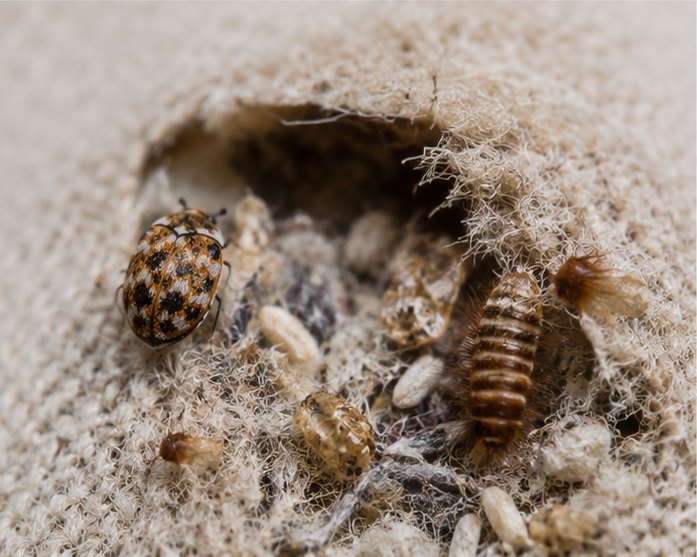
Short, stout, brownish and covered in bristles, with visible bands across the body. They curl up when disturbed. Slow-moving, unlike almost everything else you might find in a carpet.
They shed their skins as they grow, and those shed skins are frequently easier to find than the larvae - pale, hollow, and holding the shape of the animal. Finding a scatter of them in a drawer or along a carpet edge is good evidence.
The bristles are the giveaway. Carpet moth larvae are smooth and pale; carpet beetle larvae are unmistakably hairy.
This is the part that distinguishes carpet beetle from every other fabric pest and the reason it recurs so often when treated as a floor problem.
The larvae feed on keratin, and one of the richest sources of it in a building is not the carpet - it is an old bird's nest in the eaves, a roof void or a disused chimney, full of feathers and debris. A nest like that can support a population for years while the visible damage appears in the rooms below.
Old wasp and bee nests left in a roof void do the same thing, and so does a stored wool blanket, a sheepskin, a feather pillow or a rolled-up rug that has been in the loft since somebody moved in.
So the single most useful thing you can tell us is whether you have loft access, and whether there has ever been a bird, wasp or bee nest in the roof.
| What you have found | What it may actually be |
|---|---|
| Thinning or bare patches, no distinct holes | Carpet moth - grazes rather than punching through |
| Smooth pale grubs with a silken case | Carpet moth larvae |
| Small beetles in dry goods rather than fabric | Stored product beetles - a food cupboard problem |
| Holes in cotton or linen only | Not carpet beetle - they feed on animal fibre |
| A rash or irritation with no insect found | Possibly a reaction to larval hairs, though worth ruling out other causes |
No. Carpet beetles and their larvae damage natural fibres; they do not bite or feed on people. Some people do react to contact with the larval hairs, which produces irritation that gets reported as bites - so if there is skin irritation alongside fabric damage, mention both.
This single fact changes the likelihood more than anything else you could tell us, so it is worth thinking about properly rather than answering off the top of your head.
A yes to any of those, combined with small clean holes appearing in wool downstairs, makes carpet beetle considerably more likely than carpet moth - and it tells us where the survey needs to go.
Almost certainly carpet beetle larvae, often called woolly bears. Short, stout, bristly and banded, and they curl up when disturbed. They shed pale empty skins as they grow, which are often found before the larvae are.
The damage. Carpet beetle punches small, clean, sharply defined holes. Carpet moth grazes an area down into a thinning patch and leaves silken tubes in the pile. The larvae look completely different too - bristly against smooth.
Very likely. Adult carpet beetles head for the light and turn up at windows, typically in spring and early summer. It is often the first sign, before any damage is noticed - though the adults themselves do no damage.
No. They damage natural fibres and do not feed on people. Some people react to contact with the larval hairs, which can be mistaken for bites - mention it if you have irritation alongside fabric damage.
Because the source is very often an old bird's nest in the eaves or roof void, full of feathers, which can feed a population for years while the damage shows up in the rooms below. It is the single most useful thing you can tell us.
The rest of the carpet beetles advice centre, and the service page it all links back to: Carpet Beetle Control Greenwich.
Carpet beetle is the one fabric pest where treating the damaged room is only half the work. The other half is finding what has been feeding the…
Read the guide →Carpet beetle treatment is £180 for the first room and £60 for each additional one. The published price covers the rooms. Whether it covers the whole…
Read the guide →A reference rather than a checklist. Every stage of the insect, every mark it leaves, and a side-by-side comparison with carpet moth - because that…
Read the guide →Of every pest on this site, carpet beetle is the one where recurrence has the most predictable cause - and it is almost never the treatment. It is a…
Read the guide →Tell us what you have seen and where in the property you found it, and we will confirm the service and the price before anything is booked.
£180 for the first room and £60 for each additional room. Call 020 3369 0124, send the enquiry form or message us on WhatsApp.