 Zero Pest
Flats £190 | Houses £220
How Do You Know If You Have Ants in Greenwich?
Nobody needs help identifying an ant. The questions worth answering are different: is there a nest, where is it, is it yours, and does this actually…
Read the guide →Ant Control advice
Almost everyone tries the same thing first, and it is the one approach that can leave you worse off than before. Here is what is actually happening, and what works instead.
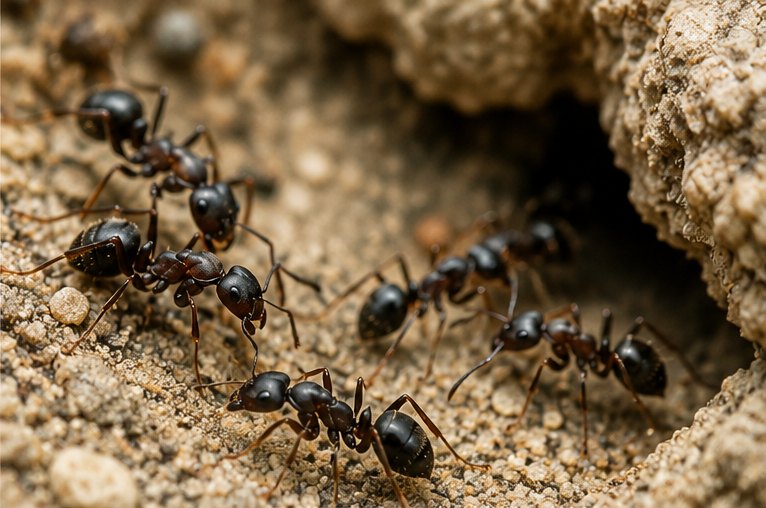
A household ant spray kills the workers it lands on. That looks like success for an afternoon.
Workers are the disposable part of a colony. They are produced continuously, and the queen producing them is not on your kitchen floor - she is under the patio, or beneath the doorstep, or in a wall void. Kill the trail on Monday and the colony sends more out by Wednesday, because nothing that mattered has changed.
That is the harmless failure. The one that costs you is this: heavy chemical disturbance around a colony can cause it to fragment. It splits and relocates into several smaller nests in new places. One trail becomes three, in three parts of the building, and the job that eventually gets done is considerably harder than the one that would have been done first.
If you have already sprayed, say so. It is not a confession and it does not change what we will do. It changes where we look, because a colony that has been disturbed is frequently no longer where the original trail said it was.
Bait is placed directly on the active trail. Workers take it, carry it back to the nest, and share it with the rest of the colony - including the parts of it that never leave the nest and could never be reached any other way.
It works precisely because it is slow. The workers have to survive long enough to get home. Anything that kills them on contact stops the delivery, which is why bait and spray work against each other and why using both is worse than using either.
The slowness is the mechanism, not a limitation of it.
This catches people out and it is entirely normal.
Bait is attractive, so activity on the trail often increases in the first day or two - sometimes noticeably. More ants, not fewer. That is recruitment working exactly as intended: the colony has found a food source and is sending workers to it, and every one of them is carrying treatment home.
The temptation at that point is to reach for the spray. Doing so ends the delivery, kills the workers mid-journey, and puts you back at the start.
Most ant jobs are resolved in a single treatment. Three situations are not, and it is worth knowing which you are in:
Once activity has stopped, the useful work is outside. Repointing a gap at a doorstep, resetting a loose slab, keeping a bin sealed, moving pet food off the floor at night. None of it is pest control and all of it reduces how attractive the property is to the next colony.
Ants are part of a garden and they always will be. The realistic goal is not a garden without ants - it is a kitchen without a trail.
The principle is identical - find the trail, follow it out, treat the colony - but three things differ in practice.
Tell us the type of premises at the enquiry, where the trail runs, what it is heading for, and any constraint on when work can be done.
No, that is normal and it is the treatment working. Bait is attractive, so the colony recruits workers to it - and every one of them is carrying treatment back to the nest. Do not spray at this point; it stops the delivery.
Please do not. Cleaning the bait away is the single most common reason an ant treatment underperforms. It needs to stay accessible until activity stops.
It kills workers, which the colony replaces continuously, and heavy disturbance can cause a colony to split into several smaller nests in new places. One trail becomes three.
It kills what it reaches, which is a small part of a colony extending well below the surface, and it damages nearby planting. It is not a treatment.
No. Ants are small enough to find another route, and unlike with rodents, closing a gap is not a meaningful barrier. The colony is what has to be dealt with.
The rest of the ants advice centre, and the service page it all links back to: Ant Control Greenwich.
Nobody needs help identifying an ant. The questions worth answering are different: is there a nest, where is it, is it yours, and does this actually…
Read the guide →Ant treatment is £190 for a flat and £220 for a house. That house figure is the odd one out on this site, and the reason it is lower says something…
Read the guide →A reference rather than a checklist. Every sign an ant colony gives away, the two species that behave differently, and the three insects people bring…
Read the guide →Ants return for four reasons, and one of them is unusual: it is caused by whatever was done last time. Working out which applies is what stops you…
Read the guide →Tell us what you have seen and where in the property you found it, and we will confirm the service and the price before anything is booked.
Flats £190 | Houses £220. Call 020 3369 0124, send the enquiry form or message us on WhatsApp.