 Zero Pest
From £180
How Do You Know If You Have Carpet Moths in Greenwich?
Most people who call us about carpet moths have seen a moth. That is the least useful piece of evidence available. The damage is what settles it, and…
Read the guide →Carpet Moth Control advice
A reference rather than a checklist. Every sign a carpet moth leaves, what it looks like, and how to separate it from the three other things that get called moths.
What to look for: thinning, then bare patches, in wool carpet. The pile is grazed down rather than perforated, so the edges of a damaged area are soft and gradual rather than sharp. Backing may become visible where it is advanced.
Where: at the edges of rooms, under furniture, beneath rugs, behind doors that stand open, along the margins of a stair runner where nobody walks.
What it rules out: small, clean, sharply defined holes are carpet beetle. Wear from foot traffic is in the walked-on middle, which is exactly where carpet moth is not.
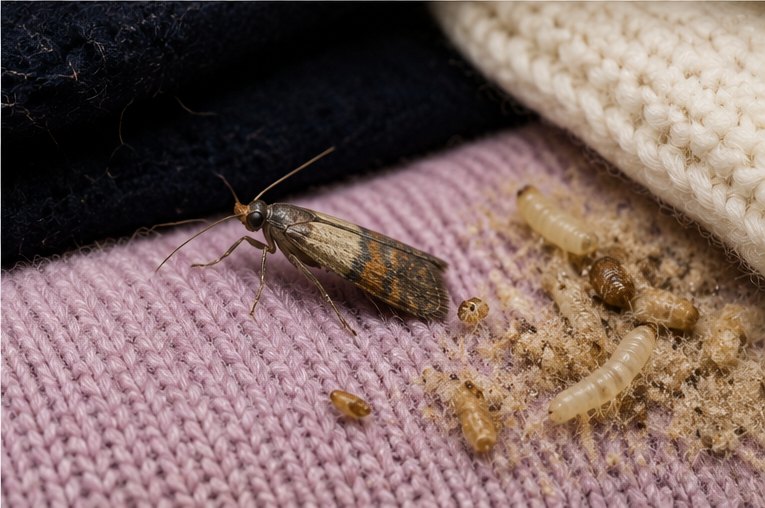
What to look for: small tubular cases in the pile, made by the larvae from carpet fibre and debris - which is why they are the same colour as the carpet and almost invisible until you know to look. Sometimes described as looking like a grain of rice made of the carpet itself.
What it tells you: confirmation. This is the sign that distinguishes carpet moth from everything else on a floor, and finding one is worth more than seeing a dozen adults.
What to look for: small, pale, cream to off-white and caterpillar-like, often partly inside a silken case and dragging it along. Smooth rather than hairy.
Where: in the pile at the edge of a room, under furniture, beneath a rug, in the gaps between floorboards.
What it rules out: short, bristly, banded larvae are carpet beetle - the hairiness is the giveaway and it is unmistakable once you have seen both.
What to look for: fine gritty material at the carpet edge and under furniture, usually the colour of the carpet. Frass, shed cases and fragments of damaged fibre.
What it tells you: active feeding. It is routinely vacuumed up as dust, which is one reason problems go unnoticed for so long.
What to look for: small, plain, buff to golden brown, and a weak flier. Tends to run, scuttle or flutter low down near skirtings rather than flying across a room, and prefers dark undisturbed places to lit ones.
What it tells you: that larvae are somewhere in the property. Nothing about where.
What it rules out: moths circling a light in the evening are almost certainly something that came in from the garden. Moths in a food cupboard are pantry moths. Neither eats carpet.
| At risk | Not at risk |
|---|---|
| Wool carpet and wool rugs | Nylon, polypropylene and polyester carpet |
| Wool underlay - including beneath a synthetic carpet | Foam and rubber underlay |
| Silk, felt and sheepskin | Cotton and linen (unless heavily soiled) |
| Feather-filled items | Synthetic filled items |
| Wool clothing, blankets and throws | Timber, plaster, food |
The rule underneath the table: they feed on keratin, the protein in animal fibre. That is the whole of it, and it explains every row.
The three-second test. Are the damaged areas grazed, or perforated? Grazed and thinning is moth. Clean holes punched through is beetle. If you can answer that from a photograph, you have already done most of the identification.
Worth doing properly and worth doing periodically, because with wool of any value the damage is done long before it is visible from standing height.
Do it twice a year on anything you would be sorry to lose, and move the rug occasionally between times. Undisturbed is the condition that matters.
Small, pale, smooth and caterpillar-like, often partly inside a silken case they drag along. Short bristly banded larvae are carpet beetle instead - the hairiness is the giveaway.
Cases built by the larvae from carpet fibre and debris, which is why they match the carpet's colour. Finding one is the clearest confirmation there is.
Almost certainly not. Carpet moths are weak fliers that stay low near skirtings and prefer dark undisturbed places. Moths circling a light have usually come in from outside.
Where the damage is. Floor, edges and under furniture is carpet moth; stored clothing inside wardrobes is clothes moth. They are close relatives and plenty of properties have both.
No - those are pantry moths in dry goods, and they have nothing to do with carpet. Different problem, different treatment.
The rest of the carpet moths advice centre, and the service page it all links back to: Carpet Moth Control Greenwich.
Most people who call us about carpet moths have seen a moth. That is the least useful piece of evidence available. The damage is what settles it, and…
Read the guide →Carpet moth treatment is almost entirely about the parts of a room nobody walks on. Everything else - the moths, the middle of the floor, the new…
Read the guide →Carpet moth treatment is £180 for the first room and £60 for each additional one. The question that actually decides your bill is which rooms count -…
Read the guide →Carpet moth recurrence has a short list of causes and almost all of them are the same thing in different clothes: somewhere undisturbed that was not…
Read the guide →Tell us what you have seen and where in the property you found it, and we will confirm the service and the price before anything is booked.
£180 for the first room and £60 for each additional room. Call 020 3369 0124, send the enquiry form or message us on WhatsApp.