 Zero Pest
Flats £190 | Houses £240
How Do You Know If You Have Cockroaches in Greenwich?
One insect running for cover is where almost every cockroach enquiry starts. Whether that means very little or a great deal depends on two things:…
Read the guide →Cockroach Control advice
A reference rather than a checklist. The two species that matter in London property, every sign each of them leaves, and how to tell them apart - because which one you have decides the entire treatment.
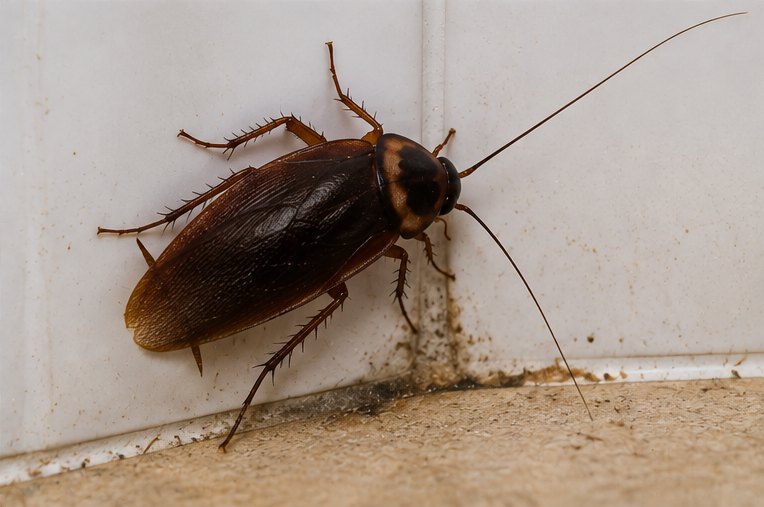
| German cockroach | Oriental cockroach | |
|---|---|---|
| Size | Small | Noticeably larger |
| Colour | Pale to mid brown | Very dark brown to near black |
| Markings | Two dark stripes behind the head | No stripes |
| Where it lives | Inside warm kitchen structure | Cool damp places - drains, gullies, basements |
| How it spreads | Between flats via risers and boxed pipework | Up from drainage and in from outside |
| Where the treatment goes | Kitchen harbourage | The drain, gully or basement it came from |
That last row is the reason this article exists. A treatment aimed at the wrong species is a treatment aimed at the wrong part of the building.
German cockroach: small, pale to mid brown, with two darker parallel stripes running back from behind the head. Fast, and it heads for a crevice rather than a corner.
Oriental cockroach: larger, glossy, very dark - often described as almost black. No stripes. Slower and more likely to be found in the open at ground level, particularly near a drain or a door.
What both rule out: anything hard-shelled and domed is probably a beetle. Anything with long back legs that jumps is a cricket. Cockroaches are flattened, run rather than jump, and seek crevices.
What to look for: smaller versions of the adult without fully developed wings. German nymphs carry the same dark stripes, which makes them identifiable even when very small. Oriental nymphs are dark and glossy.
What it tells you: breeding on the premises rather than a single insect having been carried in. Finding nymphs raises the priority considerably.
What to look for: a small, dark, purse-shaped capsule with fine ridges along one edge. German cockroach cases are usually carried by the female until close to hatching and so are found near harbourage; Oriental cases are dropped and may be found some distance away.
What it tells you: why a single treatment is not the whole job. The capsule is protective, so a treatment that deals with every live insect still leaves what is inside the cases. That is exactly what the follow-up visit is timed for.
What to look for: small dark specks, often described as resembling ground pepper or coffee grounds. In cupboard corners, along the top edges of unit carcasses, behind and under appliances, and in the runs between harbourage points. Larger species leave larger, more cylindrical droppings.
What it tells you: where the runs are, which is where the treatment goes. A concentration along the underside of a worktop tells you far more than a sighting on the floor does.
What it rules out: spilled coffee or cocoa in a drawer is the classic false positive. Droppings are uniform in size and shape; spilled grounds are not.
What to look for: a musty, slightly oily smell, most noticeable when opening a cupboard that has been shut for a while.
What it tells you: a substantial and established population. It is a late sign rather than an early one, so its absence means nothing at all.
Keep a specimen if you find a dead one. Put it in a clear bag or a small pot rather than binning it, and photograph it against something for scale. Species identification decides which part of the building gets treated, and a photograph is worth more than any description over the phone.
Useful because cockroach populations grow quickly, and knowing roughly where you are changes how urgently to act.
| What you have found | Roughly what it indicates |
|---|---|
| One insect, no other signs | Possibly carried in. Check thoroughly before assuming. |
| Droppings in one location | Established in that area. Still early. |
| Droppings in several locations | The population is using the whole run of units. |
| Nymphs of different sizes | Breeding across overlapping generations - well established. |
| Egg cases | Breeding on the premises. |
| Daytime sightings | Harbourage crowded enough to push insects into the open. |
| A noticeable smell | A substantial population. A late sign. |
The bottom three rows are the ones that should change your timetable rather than your reading. None of them is a disaster, and all of them mean the job is larger than it would have been a month earlier.
Size, colour and location. German are small, pale to mid brown with two dark stripes behind the head, and live in the warm structure of a kitchen. Oriental are larger, glossy and very dark, with no stripes, and come from drains, gullies and basements.
Small dark specks often compared to ground pepper, in cupboard corners, along the top edges of unit carcasses and behind appliances. Larger species leave larger, more cylindrical droppings.
Almost certainly an egg case. It is very good evidence, and it is the reason a follow-up visit is standard - the capsule protects what is inside from the first treatment.
Quite possibly. Ground beetles are the commonest false alarm - hard-shelled, domed, and they blunder about rather than running for a crevice. A photograph settles it.
A musty, slightly oily smell in an enclosed cupboard indicates a substantial population. It is a late sign, so not noticing one tells you nothing.
The rest of the cockroaches advice centre, and the service page it all links back to: Cockroach Control Greenwich.
One insect running for cover is where almost every cockroach enquiry starts. Whether that means very little or a great deal depends on two things:…
Read the guide →The single most useful thing to know about cockroach treatment is that the instinctive response - spraying the kitchen - makes the commonest species…
Read the guide →Cockroach control is £190 for a flat and £240 for a house. Two things decide whether that figure represents the whole cost: which species you have,…
Read the guide →Cockroach recurrence has three causes and they are easy to tell apart once you know what to look at. Two of them are about the building rather than…
Read the guide →Tell us what you have seen and where in the property you found it, and we will confirm the service and the price before anything is booked.
Flats £190 | Houses £240. Call 020 3369 0124, send the enquiry form or message us on WhatsApp.