 Zero Pest
Flats £190 | Houses £240
How to Get Rid of Cockroaches in a Greenwich Property
The single most useful thing to know about cockroach treatment is that the instinctive response - spraying the kitchen - makes the commonest species…
Read the guide →Cockroach Control advice
One insect running for cover is where almost every cockroach enquiry starts. Whether that means very little or a great deal depends on two things: what time it was, and where you were standing.
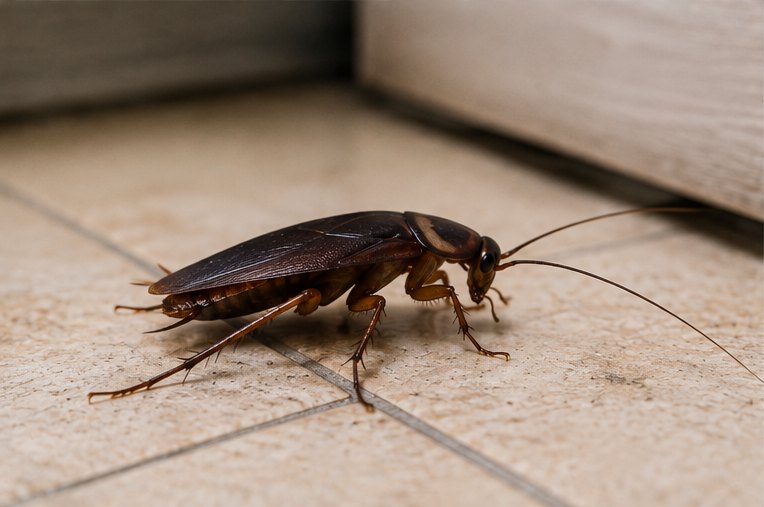
Cockroaches are nocturnal and they avoid open space. A population that is comfortable stays in the warm voids and comes out after dark, so seeing one means something specific about the state of the population.
| When you saw it | What that suggests |
|---|---|
| Late at night, kitchen light switched on | Normal behaviour. Tells you they are there, not how many. |
| In daylight, running across a floor | Usually a crowded harbourage. Insects are being pushed out to find space, which points at an established population. |
| A dead one on its back | Often somebody has already sprayed - worth telling us. |
| One, once, and never again | Possibly carried in. Check for the other signs before assuming. |
So the alarming version is not the one you saw at midnight. It is the one you saw at three in the afternoon.
This is the second question, and it decides what the treatment will be.
Warm parts of a kitchen - behind the fridge, around the cooker, inside a unit, near cabling - points at the German cockroach. Small, pale brown, lives inside the warm structure, breeds quickly, and in a block moves between flats through service risers.
Around a drain, a gully, a bin store, a basement or a lower ground floor - and usually larger and much darker - points at the Oriental cockroach. It prefers cool damp places and its origin is generally outside the room you are standing in.
You do not have to be certain. Telling us where and when you saw it usually separates them before anybody arrives.
Cockroaches are misidentified more than almost any other pest we are called about, and the mistakes go in both directions.
Photograph it if you safely can. A clear picture with something beside it for scale settles species, settles cockroach-or-not, and occasionally saves you the cost of a treatment you do not need. If you have a dead one, keep it in a clear bag rather than binning it.
Fifteen minutes with a torch, after dark, with the lights off until you are in position.
Cockroaches need warmth, moisture and small amounts of food, all of which exist in a spotless kitchen. In flats they very often arrive from elsewhere in the building entirely - through a service riser, a shared void or the gap around a waste pipe - which means the property's own housekeeping had nothing to do with it.
Worth saying because embarrassment delays calls, and with cockroaches delay is expensive: the population grows quickly and a problem that spreads into neighbouring flats becomes a much larger piece of work.
The threshold for acting is different and the record matters as much as the treatment.
Equipment housings, the voids between units and the space behind stainless steel are the usual harbourage. Access to them is what determines how much of the population a visit actually reaches, so the preparation matters more in a commercial kitchen than anywhere else.
Generally yes. Cockroaches are nocturnal and avoid open space, so a daytime sighting usually means a crowded harbourage pushing insects out to find room. It points at an established population rather than a small one.
Not necessarily - it may have been carried in. Check for the other signs first: droppings like ground pepper in cupboard corners, egg cases glued into crevices, and a musty smell in an enclosed cupboard.
Very possibly, and it is the commonest false alarm we get - particularly in ground-floor flats in summer. Ground beetles are hard-shelled, rounder, and blunder about rather than running for cover. Send a photograph.
No. They need warmth, moisture and small amounts of food, all present in a spotless kitchen. In flats they frequently arrive from elsewhere in the building through shared service routes.
Where and when you saw it usually settles it. Warm parts of a kitchen, small and pale brown, points at German cockroach. Around a drain, basement or bin store, larger and much darker, points at Oriental.
The rest of the cockroaches advice centre, and the service page it all links back to: Cockroach Control Greenwich.
The single most useful thing to know about cockroach treatment is that the instinctive response - spraying the kitchen - makes the commonest species…
Read the guide →Cockroach control is £190 for a flat and £240 for a house. Two things decide whether that figure represents the whole cost: which species you have,…
Read the guide →A reference rather than a checklist. The two species that matter in London property, every sign each of them leaves, and how to tell them apart -…
Read the guide →Cockroach recurrence has three causes and they are easy to tell apart once you know what to look at. Two of them are about the building rather than…
Read the guide →Tell us what you have seen and where in the property you found it, and we will confirm the service and the price before anything is booked.
Flats £190 | Houses £240. Call 020 3369 0124, send the enquiry form or message us on WhatsApp.