 Zero Pest
Flats £190 | Houses £240
How Do You Know If You Have Mice in Greenwich?
Most mouse problems are well established before anybody calls, and the reason is not carelessness. The evidence is small, scattered and genuinely…
Read the guide →Mouse Control advice
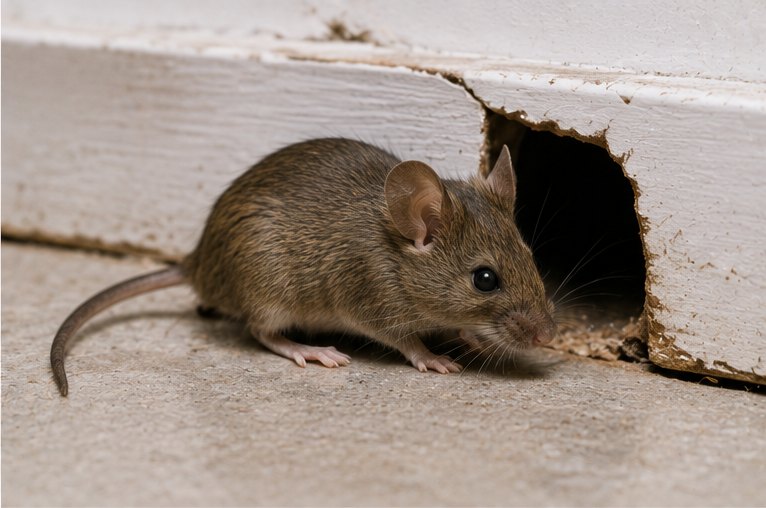
Mouse control is £190 for a flat and £240 for a house - the same figures as rat control, for a job that is not the same at all. This guide explains why, and what makes mouse work expensive when it is done badly.
| Property type | Mouse control price |
|---|---|
| Flat or apartment | £190 |
| House | £240 |
People notice that the two prices match and reasonably assume the work is interchangeable. It is not. The figures match because the amount of work involved happens to land in the same place, not because a mouse is a small rat.
Three differences change everything about how the visit is spent:
So the survey time goes into mapping the network rather than into finding one burrow, and the follow-up is about confirming the whole network was reached rather than confirming a bait point was taken.
Same reason as any property-priced service here: a house adds a suspended floor void, a roof space, an external envelope with air bricks and pipe penetrations, and often outbuildings. In mouse work the subfloor matters particularly, because a kickboard void under fitted kitchen units is very frequently open to it, and that is a route between the kitchen and the whole ground floor.
It is worth doing this arithmetic honestly, because a lot of people arrive having already spent money.
Traps and retail bait from a supermarket are inexpensive. The difficulty is that they are almost always placed where the person can reach rather than where the mice are travelling, and in numbers suited to a much smaller population than the property has. That reduces activity in one part of the house for a while, which reads as progress, and the network carries on.
Ultrasonic plug-in devices are the other common purchase. There is no good evidence they clear an established mouse population, we do not sell them and we do not recommend them. If you have one running it is worth mentioning, purely so we know what has already been tried.
Tell us what you have already done. It is not a confession, it is information. Where bait has been placed, what was taken and what was not all tell us how the population is moving and what it has learned to avoid.
In houses - particularly the interwar and 1930s stock across Eltham and the estate housing further out - mice are very often incomers rather than residents. Activity that starts in October in a property that was quiet all summer is pointing at an entry point, not a long-established colony.
That is the situation where proofing earns its money, and it is priced separately at £180, up to 1 hour for exactly the reason set out on the pest proofing page: the amount needed varies enormously, and bundling it would mean the people who need none subsidise the people who need hours of it.
The practical version: treatment removes the mice that are in. Closing the air brick or the pipe entry decides whether next October is a repeat.
In a block or a converted house, mice move between flats through service risers, boxed pipework and the gaps around waste pipes. A population on one floor can be feeding on another, and a single-flat treatment reaches a fraction of it.
We will say so plainly when that is what the evidence shows, rather than selling repeat treatments that cannot reach the problem. The effective instruction in that situation is a building-wide one through the managing agent, and a report describing which penetrations are open and where is usually what makes that conversation move.
Greenwich, Blackheath, Woolwich, Eltham, Charlton, Plumstead and Abbey Wood, all at the published figure. No travel loading, no postcode adjustment.
The published price buys a treatment. It does not buy a promise that the treatment can reach a problem that is not inside your property, and there are three situations where we will say so before you spend the money rather than after.
In a block or a converted house, where the routes run through service risers and communal voids, a single-flat treatment reaches a fraction of the population. The effective instruction is a building-wide one through the managing agent, and a report describing which penetrations are open and where is what moves that along.
In terraced housing the void beneath a suspended floor frequently does not stop at the party wall, and neither does the roof space. If your neighbours have the same thing, that is genuinely useful information and it changes the plan.
An accessible bin store, a neighbouring property with a long-standing problem, or feed and spillage in a shared area. Treatment against a continuous food supply is a holding operation, and it should be sold as one or not at all.
Because the amount of work happens to land in the same place, not because it is the same job. Mouse work spends its time distributing control across a network of routes; rat work spends it on a smaller number of heavily used runs.
It varies with how established the population is and how much of the building it is using. The published figure covers the treatment programme rather than a single call, and the follow-up is what confirms the whole network has been reached.
Leave them where they are and tell us about them at the survey. Where they have been placed and what has happened to them is genuinely useful information about how the mice are moving.
There is no good evidence they clear an established mouse population. We do not sell or recommend them. If one is plugged in, it is worth mentioning so we know what has been tried.
Often, in a house. Mice are frequently incomers rather than residents, and the route in is usually findable. Proofing is £180, up to 1 hour and quoted separately so you can see the treatment and the repair as two figures.
The rest of the mice advice centre, and the service page it all links back to: Mouse Control Greenwich.
Most mouse problems are well established before anybody calls, and the reason is not carelessness. The evidence is small, scattered and genuinely…
Read the guide →Almost everyone tries something before they call, and almost everyone tries the same thing: a trap or a bait point where the droppings were. Here is…
Read the guide →A reference rather than a checklist. Every sign a mouse leaves, what it actually looks like, what it tells you, and what it rules out - including the…
Read the guide →Every autumn, in the same house, in the same cupboard. Or a fortnight of quiet after a treatment and then droppings again. Both are common, and they…
Read the guide →Tell us what you have seen and where in the property you found it, and we will confirm the service and the price before anything is booked.
Flats £190 | Houses £240. Call 020 3369 0124, send the enquiry form or message us on WhatsApp.