 Zero Pest
Flats £190 | Houses £240
How Do You Know If You Have Mice in Greenwich?
Most mouse problems are well established before anybody calls, and the reason is not carelessness. The evidence is small, scattered and genuinely…
Read the guide →Mouse Control advice
A reference rather than a checklist. Every sign a mouse leaves, what it actually looks like, what it tells you, and what it rules out - including the signs people expect to find and will not.
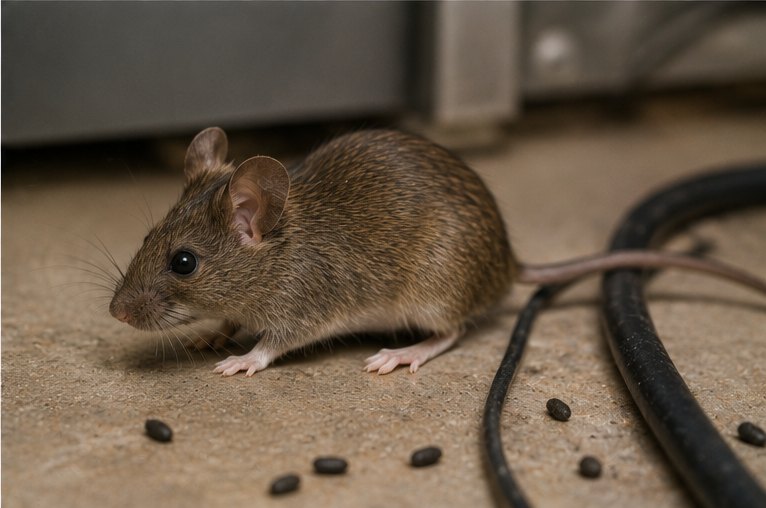
What to look for: very small, dark, roughly rice-grain shaped, and pointed at the ends. Fresh ones are dark and slightly soft; older ones are grey, hard and crumble when moved.
What it tells you: location and spread, more than numbers. Mice produce a great many droppings and do not confine them to one route, so the useful information is which cupboards, drawers and corners rather than how many. A spread across several separate places in a kitchen usually means the population is using the whole run of units rather than one corner.
What it rules out: substantially larger capsule-shaped droppings gathered along a single route are rats. Larger still, in a loft, with daytime noise, may be squirrel.
What to look for: a small, fairly neat hole in the corner of a box or a bag - cereal, pasta, rice, dry pet food - with the rest of the packet undisturbed. Often accompanied by a little spilled contents and droppings nearby.
What it tells you: that the cupboard is on an active route and that there is a food source keeping the population where it is. It is also the most common first discovery in a mouse problem.
What it rules out: coarse damage that removes a lot of material, or damage to non-food items like cable and timber, is more characteristic of rats.
What to look for: shredded paper, cardboard, insulation, fabric or loft wool, pulled apart and gathered into a loose mass. Behind an appliance, inside a boxed-in space, in the back of a low cupboard, in a drawer that is rarely opened, or in loft insulation.
What it tells you: that you have found a nesting site. This is the sign people most often misread, because finding one nest feels like finding the problem. Mice maintain several sites in a single property, so a nest is a data point rather than a conclusion.
What to look for: light, quick, scuttling movement rather than thumping. Behind a kitchen unit, inside a stud wall, above a ceiling. Often described as sounding higher up and faster than people expect.
What it tells you: roughly where the runs are, particularly if you can locate it to a specific wall or unit on more than one night.
What it rules out: heavy, weighty movement points at rats; heavy movement in daylight in a loft points at squirrels.
What to look for: a stale, musky, slightly sweet smell, strongest in an enclosed space that has been shut for a while.
What it tells you: where the nesting is, which is often not where the droppings are. It is worth following, because the nesting site is what the treatment needs to reach.
What to look for: a faint dark mark at the edge of a frequently used gap, such as a hole in a kickboard.
What it tells you: that a particular opening is in heavy use.
What it rules out: this is included mainly to save you looking. Mice generally do not leave the pronounced greasy smear that rats do. If you have found a clear, dark, built-up smear along a wall or joist, that is a point in favour of rats rather than mice.
What to look for: small footprints and a fine tail line in dust, or in a thin dusting of flour laid down deliberately overnight.
What it tells you: that the route is in use now. This is the most valuable evidence a householder can produce, because unlike droppings it cannot be left over from last year.
What to look for: stripped or nicked cable sheathing, particularly in a loft, under a floor or behind an appliance.
What it tells you: that this has stopped being only a nuisance. Rodents gnaw constantly because their incisors grow continuously, and damaged cable insulation is a genuine fire risk. It is the one sign on this page that should change how quickly you act.
The pencil test. Rather than quoting a gap measurement at you, the practical rule we use on site is this: if you can push a pencil into a gap, treat it as a possible route until proven otherwise. It is more useful than a figure and it is easy to apply with a torch.
Droppings in more than one location plus any second sign - gnawed packaging, nesting material, tracks, a smell - is enough to act on. A single find in a single cupboard is a reason to clear it, mark the date and look again in a few days.
Worth listing, because a treatment aimed at the wrong thing is money spent for nothing and these come up often.
If you are unsure, a clear photograph sent with the enquiry costs nothing and occasionally saves a visit you did not need.
Very small, dark, roughly rice-grain shaped and pointed at the ends. They scatter through cupboards and drawers rather than gathering along one route, which is the clearest difference from rats.
You have found a nesting site. Mice maintain several in a single property, so it is a useful data point rather than a conclusion - and it is the reason clearing one spot often produces a fortnight of quiet and no more.
Probably not. Mice do not generally leave the pronounced greasy smear that rats do. If you have found a clear dark built-up smear along a wall, that points at rats.
Smaller than most people expect. Rather than quote a figure, the practical test we use is this: if you can push a pencil into a gap, treat it as a possible route until proven otherwise.
Yes - it is the one sign that should make you act faster. Damaged cable insulation in a loft or under a floor is a genuine fire risk, and it is worth having an electrician look at it as well as dealing with the mice.
The rest of the mice advice centre, and the service page it all links back to: Mouse Control Greenwich.
Most mouse problems are well established before anybody calls, and the reason is not carelessness. The evidence is small, scattered and genuinely…
Read the guide →Almost everyone tries something before they call, and almost everyone tries the same thing: a trap or a bait point where the droppings were. Here is…
Read the guide →Mouse control is £190 for a flat and £240 for a house - the same figures as rat control, for a job that is not the same at all. This guide explains…
Read the guide →Every autumn, in the same house, in the same cupboard. Or a fortnight of quiet after a treatment and then droppings again. Both are common, and they…
Read the guide →Tell us what you have seen and where in the property you found it, and we will confirm the service and the price before anything is booked.
Flats £190 | Houses £240. Call 020 3369 0124, send the enquiry form or message us on WhatsApp.