 Zero Pest
Flats £190 | Houses £240
How Do You Know If You Have Mice in Greenwich?
Most mouse problems are well established before anybody calls, and the reason is not carelessness. The evidence is small, scattered and genuinely…
Read the guide →Mouse Control advice
Almost everyone tries something before they call, and almost everyone tries the same thing: a trap or a bait point where the droppings were. Here is why that produces a fortnight of quiet, and what actually works.
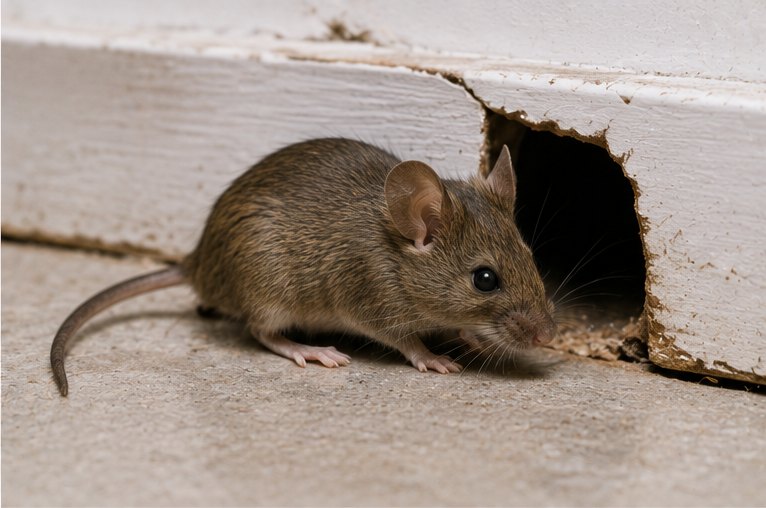
It is a completely reasonable thing to do and it fails for a specific reason worth understanding, because it explains the shape of everything else on this page.
A mouse population does not live where you found the droppings. It lives in voids - under the kickboard, behind the units, in the subfloor, inside a stud wall, in the boxing around pipework - and it uses the cupboard as one of many feeding points. Mice sample small amounts in a lot of places rather than feeding heavily in one.
So a single trap catches whichever animals use that particular spot. It genuinely reduces activity there, which reads as progress. The rest of the network is untouched, and within two or three weeks it has redistributed.
The population is a network. Anything that treats one point of it is treating a symptom.
One thing genuinely works in your favour, and it is worth knowing because it sets a fair expectation.
Mice are inquisitive about new objects rather than suspicious of them. That is the opposite of a rat, and it means uptake usually begins quickly rather than after a wary fortnight. What takes the time in mouse work is not getting them to engage - it is reaching all of the network rather than the part of it you had noticed.
Worth checking yourself with a torch, because the list is short and the routes are usually findable:
If you can push a pencil into a gap, treat it as a possible route until proven otherwise.
The routes usually belong to the property, which means they can genuinely be closed. That is why rodent problems in the interwar and 1930s housing across Eltham and the estate housing further out are so often seasonal rather than permanent - and why proofing at £180, up to 1 hour is frequently cheaper than a second treatment next autumn.
The routes are frequently in shared structure - service risers, communal voids, the gaps around waste pipes between floors. Sealing your own flat reduces what reaches your rooms and it does not close the building. Where the evidence says the population belongs to the building, we will say so rather than sell repeat treatments that cannot reach it.
Activity dropping rather than stopping dead on the first night. Some continued evidence in the days after the first visit, which is normal. A follow-up that confirms whether the network was reached. And then - if the route has been closed and the food source dealt with - quiet that lasts, rather than quiet that ends in three weeks.
Not a promise - it depends on how established the population is and whether the route is inside your control - but this is the shape of a job that is going well.
A job that is not going well looks different: quiet for two or three weeks, then the same cupboard again. That is a coverage problem, not a product problem, and it is worth saying so rather than repeating the same visit.
Usually because they caught the animals using that particular spot and the rest of the network carried on elsewhere. Mice feed in small amounts at many points, so coverage matters more than the product.
Uptake usually begins quickly, because mice investigate new objects readily rather than avoiding them. What takes the time is reaching the whole network rather than the part you had noticed, which is what the follow-up is for.
A cat may reduce activity in the rooms it patrols but cannot reach a nesting site inside a wall or under a floor, which is where the problem generally lives.
There is no good evidence they clear an established mouse population. We do not sell or recommend them. If one is plugged in it is worth mentioning, purely as information about what has been tried.
Not yet. Sealing the route while mice are inside leaves them in the building, and the usual consequence is a smell in a wall cavity and plasterwork coming off to find it. Proofing goes after the treatment.
The rest of the mice advice centre, and the service page it all links back to: Mouse Control Greenwich.
Most mouse problems are well established before anybody calls, and the reason is not carelessness. The evidence is small, scattered and genuinely…
Read the guide →Mouse control is £190 for a flat and £240 for a house - the same figures as rat control, for a job that is not the same at all. This guide explains…
Read the guide →A reference rather than a checklist. Every sign a mouse leaves, what it actually looks like, what it tells you, and what it rules out - including the…
Read the guide →Every autumn, in the same house, in the same cupboard. Or a fortnight of quiet after a treatment and then droppings again. Both are common, and they…
Read the guide →Tell us what you have seen and where in the property you found it, and we will confirm the service and the price before anything is booked.
Flats £190 | Houses £240. Call 020 3369 0124, send the enquiry form or message us on WhatsApp.