 Zero Pest
Flats £190 | Houses £240
How Do You Know If You Have Rats in Greenwich?
Most people call us at the point where they suspect rats but cannot prove it. This guide is about that gap: what genuinely counts as evidence, what…
Read the guide →Rat Control advice
A reference rather than a checklist. Each sign a rat leaves, what it actually looks like, what it tells you, and - just as usefully - what it rules out. Worth reading with the light on and a torch in your hand.
What to look for: dark, capsule-shaped and substantially larger than mouse droppings. Fresh ones are dark and soft-looking; older ones are grey, dry and crumble.
What it tells you: more than any other single sign. The location tells you where the route runs, because rats travel the same path repeatedly and droppings gather along it - a skirting line, behind an appliance, under a sink, along a joist. A concentration in one place is a run; a scattering across several cupboards is more characteristic of mice.
What it rules out: a scattering of very small droppings through drawers and cupboards is mouse rather than rat. Larger, more irregular droppings in a loft with daytime activity may be squirrel.
What to look for: a dark, greasy, slightly shiny mark along the base of a wall, around the edge of a hole, along a pipe run or over a joist. It builds up over time and does not wipe away easily.
What it tells you: that the route has been in regular use for a while, and exactly where it runs. Rats keep body contact with a surface as they travel, which is what leaves the mark, so a smear at the edge of a gap is confirmation that the gap is a working entry point rather than just a hole.
What it rules out: mice generally do not produce noticeable smear marks. This is one of the more reliable discriminators between the two.
What to look for: damage to things that are not food. Cable sheathing, plastic pipework, timber, the corner of a plasterboard wall, the edges of stored boxes, the lip of a door. Rat gnawing is coarser and removes more material than mouse gnawing.
What it tells you: rodents gnaw constantly because their incisors grow continuously, so gnawing is not a sign of hunger - it is a sign of occupancy. Damage near cabling matters more than damage anywhere else, because it is a genuine fire risk.
What it rules out: very neat small holes in food packaging, with the rest of the packet undisturbed, are more characteristic of mice.
What to look for: holes in the ground against a wall, under decking, beside a shed base, at the edge of a patio or next to a drain cover. Look for a worn path leading away from them - a run through grass, a flattened line along a fence base, a bare strip where vegetation has been pushed aside.
What it tells you: that the population is established outside and where its territory runs. A burrow with a clean, open entrance and a worn run is active; one that is partly collapsed and has vegetation growing across it is not.
What it rules out: mice do not usually excavate burrows of this kind in a garden setting.
What to look for: movement with weight behind it - under floorboards, in a ceiling void, behind a stud wall. Usually after dark, and usually in the same part of the property each night.
What it tells you: less than people think on its own, and quite a lot in combination with the time of day and the consistency of location. Repetition in one place over several nights is meaningful; a single noise once is not.
What it rules out: heavy movement during daylight hours points at squirrels rather than rats. Light, quick, high-up movement points at mice.
What to look for: a persistent, sharp, ammoniacal smell coming from one specific area rather than a whole room. Strongest in enclosed spaces - a cupboard that has been shut, a void, a subfloor.
What it tells you: an established population close by, or a dead animal. Both are worth investigating; they are not the same problem and the survey will separate them.
What it rules out: very little on its own. Drain faults and damp produce smells that people reasonably mistake for this.
What to look for: footprints and tail drag marks in dust, or in a thin dusting of flour laid down deliberately overnight.
What it tells you: that a route is in current use, which is different from evidence that it was used at some point. This is the most useful thing a householder can produce, because it is current and it is specific.
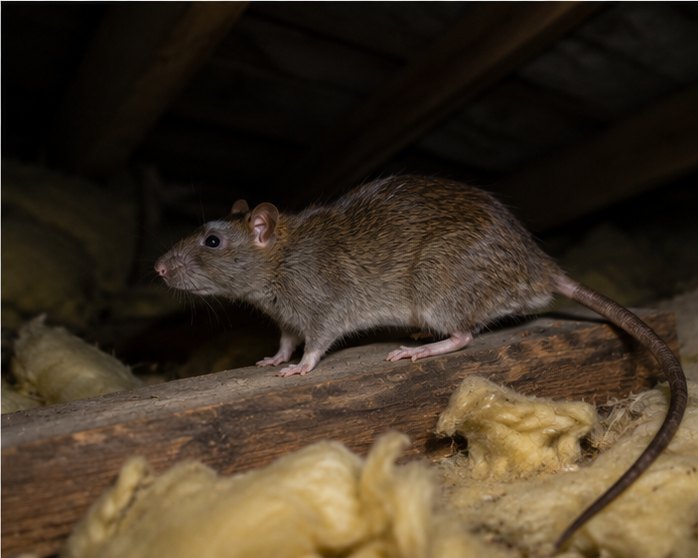
What to look for: loft insulation pulled apart, compressed into a mass, or with runs pushed through it.
What it tells you: nesting activity in the roof void.
What it rules out: insulation torn up and gathered in quantity near the eaves, combined with daytime noise, points at squirrels rather than rats - and squirrel work is a different service with a legal framework of its own.
Photograph, do not handle. Droppings, nesting material and gnawed material are all worth photographing with something beside them for scale, and none of them are worth picking up. Leave the evidence in place until the survey - where it is tells us as much as what it is.
One sign is a reason to look harder. Two independent signs - droppings and a smear mark, tracks and gnawing, a burrow and a run - are a reason to act.
And if the picture that emerges points at mice, or at squirrels, tell us that at the enquiry. Getting the animal right first is what stops a treatment being aimed at the wrong problem.
Not every sign carries the same urgency, and it is worth separating the ones that justify waiting a few days from the ones that do not.
The middle ground - two signs, indoors, current - is where most enquiries sit, and it is a reasonable point to pick up the phone.
Droppings gathered along a route rather than scattered, closely followed by a dark greasy smear mark along a wall or joist. The smear is particularly useful because mice generally do not produce one.
An active burrow has a clean, open entrance and usually a worn run leading away from it. One that is partly collapsed with vegetation growing across the entrance is not in current use.
Rat gnawing is coarser and removes more material - cable sheathing, timber, plasterboard corners. Mice tend to leave neat small holes, particularly in food packaging, with the rest of the packet undisturbed.
No. A persistent sharp smell from one specific area is worth investigating, but drain faults, damp and a dead animal of any species all produce smells people reasonably mistake for rodents.
If the activity is in a loft and happens in daylight, quite possibly. Torn-up insulation gathered near the eaves and gnawed cabling point the same way. That is a different service with a different legal position, so it is worth establishing.
The rest of the rats advice centre, and the service page it all links back to: Rat Control Greenwich.
Most people call us at the point where they suspect rats but cannot prove it. This guide is about that gap: what genuinely counts as evidence, what…
Read the guide →What genuinely works, what wastes money, and how long it takes. This is the process from the inside, including the parts most companies do not put on…
Read the guide →Rat control in Greenwich is £190 for a flat and £240 for a house. This guide explains what that difference actually pays for, what is inside the…
Read the guide →Treated, quiet for a fortnight, and then back. It is the most frustrating version of this problem and it almost always has one of five explanations -…
Read the guide →Tell us what you have seen and where in the property you found it, and we will confirm the service and the price before anything is booked.
Flats £190 | Houses £240. Call 020 3369 0124, send the enquiry form or message us on WhatsApp.