 Zero Pest
£280 trapping service
How Do You Know If You Have Grey Squirrels in Greenwich?
One question settles this more reliably than anything else, and you can answer it tonight: what time of day do you hear it? Squirrels are active in…
Read the guide →Squirrel Control advice
A reference rather than a checklist. Every sign a grey squirrel leaves on a building, what it looks like, and how each one separates squirrels from the rats, mice and birds people confuse them with.
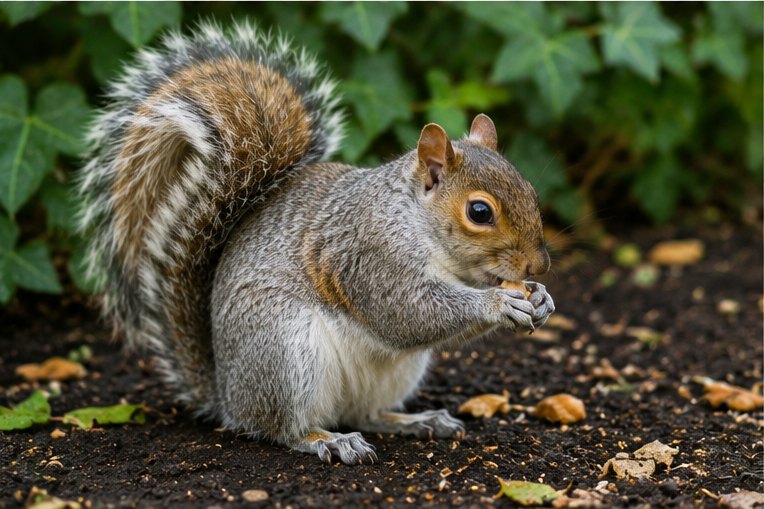
What to look for: heavy movement - thumping, rolling, dragging, scampering with weight behind it - concentrated in daylight, particularly morning and late afternoon.
What it tells you: more than any other single sign. Grey squirrels are diurnal. Timing alone separates them from rats and mice more reliably than anything you could see.
What it rules out: activity concentrated after dark is rodents. Light, fast, high-up sound during the day, especially in spring, is more likely to be birds in the eaves.
What to look for: a chewed or broken edge on a soffit or fascia board, a gap at a gable verge, a displaced or lifted tile, or a hole where two roof elements meet. Fresh damage shows pale exposed timber against weathered surface.
What it tells you: the entry point, which is the thing that eventually has to be closed. Squirrels will enlarge an existing weakness rather than start from nothing, so the damage usually sits where something was already failing.
What it rules out: rats and mice rarely produce visible roofline damage of this scale. A hole big enough to see from the garden is a squirrel-sized clue.
What to look for: coarse gnawing on timber - joists, rafters, boarding - and on cable sheathing and plastic pipework. Broad, deep tooth marks rather than the fine nibbling of a mouse.
What it tells you: occupancy, and in the case of cable, urgency. Squirrels gnaw constantly because their incisors grow continuously, so gnawing is not a sign of hunger.
Why cable matters most: damaged insulation in a loft is a genuine fire risk. It is the one sign on this page that should change how quickly you act, and it is worth an electrician looking at it as well.
What to look for: loft insulation torn apart, compressed and gathered into a mass, usually towards the eaves. Sometimes with clear runs pushed through it between the nest and the entry point.
What it tells you: nesting rather than passing through, which means an established presence and possibly a drey with young.
What it rules out: rats and mice disturb insulation but rarely gather it in quantity like this. The scale is the distinguishing feature.
What to look for: larger than rat droppings, more rounded and more irregular in shape, often paler and scattered rather than gathered in a run.
What it tells you: confirmation, though it is less useful than the timing of the noise. Photograph rather than handle them.
What it rules out: small dark capsule-shaped droppings collecting along a route are rats. Very small rice-grain droppings scattered in cupboards are mice.
What to look for: a bulky ball of twigs, leaves, moss, shredded bark and - inside a building - insulation, paper and fabric. In a loft it is usually tucked into the eaves or against a chimney breast.
What it tells you: that this is a nest site rather than a through-route, and that it may contain dependent young depending on the time of year. That possibility is the strongest single reason never to block an entry point before the loft has been checked.
What to look for: nuts, seeds or fragments of them tucked into insulation, between joists or in a corner. Sometimes shell debris.
What it tells you: a squirrel rather than anything else - no other loft occupant caches food like this. It also explains the rolling noise people report, which is cached items moving across the ceiling.
What to look for: bark stripped from branches near the property, and pale scraped areas on exterior timber.
What it tells you: squirrels active in the immediate area, though not necessarily inside your building. Useful as corroboration rather than as evidence in itself.
What to look for: an overhanging branch reaching the roof, a fence line running to a wall, a cable, or a neighbouring roof in a terrace.
What it tells you: where the survey should start, and what the long-term fix looks like. Squirrels do not climb walls, so if none of these exists on your property the entry point may be several doors along in a terraced run.
The twenty-minute test. Watch the roofline from the garden on a bright morning. If there is an active entry point you will very likely see an animal use it, and that is more conclusive than every other sign on this page put together.
Useful for deciding how urgently to act, and for knowing what else may need attention beyond the animals themselves.
| What you have found | Roughly what it indicates |
|---|---|
| Noise only, no visible damage | Possibly recent, or an entry point you have not spotted yet |
| A visible hole at the roofline | Established access. The repair is now part of the job. |
| Insulation disturbed but not gathered | Passing through rather than nesting |
| Insulation gathered into a mass | Nesting. Possibly a drey, possibly with young. |
| Cached nuts or shell debris | Settled in, and using the loft as a store as well as a nest |
| Gnawed cabling | Long enough to have caused a genuine hazard |
| Water staining below the entry point | The roofline has been open long enough for weather to get in |
The last two rows are the ones that turn this from a noise problem into a building problem, and they are the reason an early call is worth making.
Larger than rat droppings, more rounded and irregular, often paler, and scattered rather than gathered along a route. Photograph rather than handle them - though the timing of the noise is more useful evidence anyway.
The nest - a bulky ball of twigs, leaves, moss and, inside a building, insulation and shredded material. Usually in the eaves or against a chimney breast. It may contain dependent young, which is why an entry point should never be blocked before the loft is checked.
Cached food moving across the joists. Squirrels store nuts and seeds in the loft, and it produces a sound people find genuinely strange until they know what it is.
Scale. Squirrel gnawing is coarse and deep, on timber, cable and pipework, and can produce roofline damage visible from the garden. Rat gnawing is smaller, and mice leave fine nibbling.
If it is light, fast, right at the edge of the roof and mostly in spring, quite possibly. Squirrel movement is heavy and comes with insulation damage and gnawing that birds do not produce.
The rest of the squirrels advice centre, and the service page it all links back to: Squirrel Control Greenwich.
One question settles this more reliably than anything else, and you can answer it tonight: what time of day do you hear it? Squirrels are active in…
Read the guide →This is the one service on the site where the law decides the method before anything else does. Understanding that first explains why the job looks…
Read the guide →Squirrel control is £280 for the trapping service. That is one figure for a programme of visits rather than a price per call, and the reason it works…
Read the guide →A loft cleared in February and occupied again by November is the classic pattern, and it is not a failed programme. It is an available cavity with a…
Read the guide →Tell us what you have seen and where in the property you found it, and we will confirm the service and the price before anything is booked.
£280 trapping service. Call 020 3369 0124, send the enquiry form or message us on WhatsApp.