 Zero Pest
£280 trapping service
How to Get Rid of Grey Squirrels in a Greenwich Property
This is the one service on the site where the law decides the method before anything else does. Understanding that first explains why the job looks…
Read the guide →Squirrel Control advice
One question settles this more reliably than anything else, and you can answer it tonight: what time of day do you hear it? Squirrels are active in daylight and rats are not, and that single fact does most of the diagnostic work.
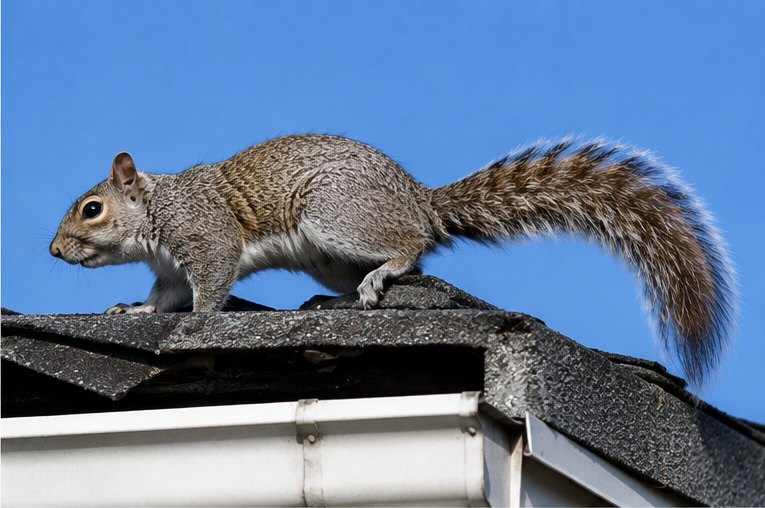
Heavy movement in a loft at three in the afternoon is far more likely to be a squirrel than a rat. Rats are nocturnal; grey squirrels are diurnal, most active in the morning and again in the late afternoon.
So before anything else, spend two days noting when you hear it. Not how loud and not how often - when.
| When you hear it | What it suggests |
|---|---|
| Morning and late afternoon, in daylight | Grey squirrel |
| After dark, and quiet during the day | Rats or mice |
| Daytime, but light and fast rather than heavy | Birds in the eaves, particularly in spring |
| All hours, heavy, with no pattern | Worth a survey - it may be more than one thing |
Squirrels are heavy, and people describe the noise in ways they never use for rodents: thumping, rolling, dragging, scampering with real weight behind it. Something being carried across a ceiling. A distinct sense of an animal the size of a cat rather than the size of a mouse.
The rolling sound is worth mentioning because it is fairly distinctive - squirrels cache food, and nuts moving across joists produce a noise people find genuinely strange until they know what it is.
This is the part most people skip, and it is where the answer usually is. From the garden, in good light, with binoculars if you have them:
Squirrels do not climb a wall to reach a loft. They arrive along something, and identifying that something tells you a great deal:
If your property has none of those and you are hearing daytime activity, it is worth widening the search rather than assuming - in a terrace the entry point may be several doors along.
Only if the access is safe and you are comfortable doing it. Do not go into a loft where you suspect an animal is present if you are not confident.
Gnawed cable changes the urgency. Squirrels gnaw constantly because their incisors grow continuously, and damaged cable insulation in a loft is a genuine fire risk. If you find it, that is a reason to act now and to have an electrician look at it, not just a reason to book pest control.
Grey. Red squirrels are a protected species and are confined to a small number of areas - parts of Scotland, Northumberland, Cumbria, the Isle of Wight, Anglesey, Brownsea Island - and are not found in Greater London. Anything in a loft in Greenwich is a grey squirrel.
That matters because the legal position for greys is specific, and it shapes how the work has to be done. There is more on that in the guide on getting rid of them.
Squirrels use lofts most in the colder months and around breeding, so activity reported in late winter and early spring is common. That is also the period when a drey may contain dependent young - which is one of the strongest reasons never to block an entry point before the loft has been checked.
Squirrels in a roof void are a building matter rather than a tenant one, and there are three things worth establishing early.
The report will record the entry point, the insulation damage and any gnawed cabling found, which is usually what is needed to get the roofline repair authorised alongside the pest work.
Time of day, more reliably than anything else. Squirrels are active in daylight, most often morning and late afternoon; rats are nocturnal. Heavy daytime movement in a loft points firmly at squirrels.
Heavy - thumping, rolling, dragging, and a sense of an animal the size of a cat rather than a rodent. The rolling sound is often cached nuts moving across joists, which people find genuinely puzzling until they know.
No. Red squirrels are protected and confined to a small number of areas, none of them in Greater London. Anything in a loft here is a grey.
Along something - an overhanging branch, a fence line running to a wall, a cable, or a neighbouring roof in a terrace. They do not climb walls, so identifying the route tells you a lot.
Urgent. Damaged cable insulation is a genuine fire risk, and it is worth having an electrician look at it as well as dealing with the animals.
The rest of the squirrels advice centre, and the service page it all links back to: Squirrel Control Greenwich.
This is the one service on the site where the law decides the method before anything else does. Understanding that first explains why the job looks…
Read the guide →Squirrel control is £280 for the trapping service. That is one figure for a programme of visits rather than a price per call, and the reason it works…
Read the guide →A reference rather than a checklist. Every sign a grey squirrel leaves on a building, what it looks like, and how each one separates squirrels from…
Read the guide →A loft cleared in February and occupied again by November is the classic pattern, and it is not a failed programme. It is an available cavity with a…
Read the guide →Tell us what you have seen and where in the property you found it, and we will confirm the service and the price before anything is booked.
£280 trapping service. Call 020 3369 0124, send the enquiry form or message us on WhatsApp.