 Zero Pest
£280 trapping service
How Do You Know If You Have Grey Squirrels in Greenwich?
One question settles this more reliably than anything else, and you can answer it tonight: what time of day do you hear it? Squirrels are active in…
Read the guide →Squirrel Control advice
This is the one service on the site where the law decides the method before anything else does. Understanding that first explains why the job looks the way it does - and why one very common instinct is the worst possible move.
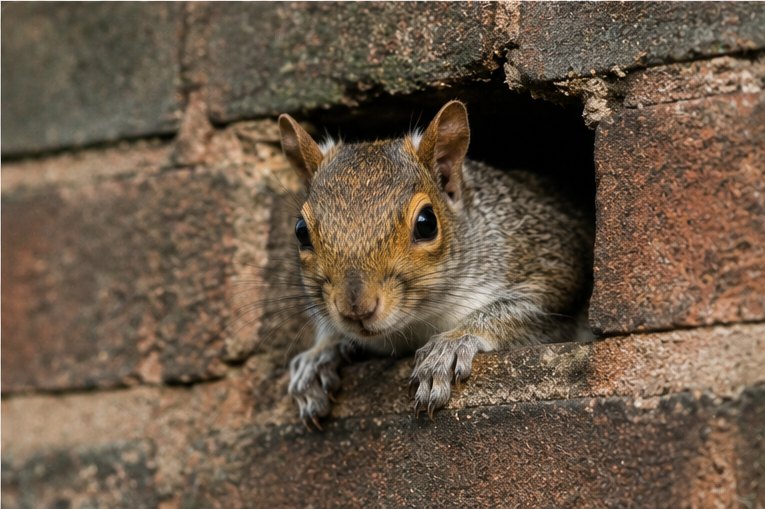
The grey squirrel is a non-native invasive species in Great Britain. It is an offence to release a grey squirrel back into the wild or to allow one to escape.
That single fact removes the option almost everybody asks about first, and asks about for entirely decent reasons: catch it and let it go in the park. No company can lawfully offer that. If somebody quotes you for a humane relocation, they are either misinformed or telling you what you want to hear.
Trapping also carries duties of its own. Traps must be of an approved type used in the way they are approved for, and they must be checked frequently so that nothing is left in one. Frequent checking means repeat visits, which is why this is a programme rather than a call-out.
This describes how the work is carried out. It is not legal advice. If you need a definitive position on the law as it applies to your circumstances, take proper advice. What we can tell you is how Zero Pest Greenwich operates: lawfully, humanely, and without pretending a relocation option exists when it does not.
The most common and most expensive DIY mistake in squirrel work, and it is worth being emphatic about.
Sealing the roofline while animals are still inside traps them in the loft. They will do considerably more damage getting out than they were doing before - gnawing through timber, plasterboard and whatever else is between them and the outside. And if there are dependent young in a drey, blocking the entrance shuts them in with no adult able to reach them.
That produces exactly the outcome nobody wants, plus a smell in a ceiling void and a job that now involves opening up plasterwork to find it.
Proofing goes last. Always. If you have already blocked a hole and are now hearing activity inside, say so immediately at the enquiry rather than waiting for a routine appointment.
One published figure - £280 trapping service - covers the programme rather than a price per visit. Frequent trap checking is a requirement of doing the work properly rather than an optional extra, so charging per visit would be charging you for the obligation.
| Item | Position |
|---|---|
| Trapping programme and visits | £280 trapping service |
| Proofing the entry point | £180, up to 1 hour – after the loft is clear |
| Roofing repair to a rotten soffit or failed verge | A roofer will quote it |
| Electrical work where cable is damaged | An electrician will quote it |
| Cutting back an overhanging branch | A tree surgeon, or you |
| Replacing damaged insulation | A separate trade |
These are separated deliberately. A single figure that quietly included work we cannot actually do is how a customer ends up paying for a repair that never happened.
It affects both the timing and the welfare of the job, and it is the question people are most reluctant to ask.
A drey in a loft may contain dependent young, particularly at certain times of year. Where the survey finds that, it changes how the work is carried out - and it is the strongest possible reason not to seal the roofline first.
We survey for it before anything is placed and we will tell you what we found. The work is carried out lawfully and humanely, and the sequence above exists precisely to avoid the situation where young are shut in.
Longer than a treatment and shorter than people fear. It is a series of visits over a period rather than a single call, and it continues until activity has stopped and the loft is confirmed clear.
What extends it is usually one of two things: a terrace where the entry point is not above your own property, or an entry route - a branch, a cable - that keeps supplying new animals into a territory that has just been vacated.
This is the question people most want to ask and most often do not, and websites in this trade tend to talk around it. You are entitled to a straight answer before you book rather than afterwards, so here it is.
Because releasing a grey squirrel back into the wild is an offence, a trapped animal cannot be taken somewhere else and let go. It is dispatched on site, humanely, by an appropriate and lawful method, by somebody trained to do it.
That is the whole of it, and it is why the relocation question matters so much earlier in the process. Anybody offering to catch and release is either describing something unlawful or is not being straight with you about what will actually happen to the animal.
The obligations that go with it are the reason the work is done the way it is: approved trap types used as approved, frequent checking so that nothing is left in a trap, and a survey beforehand for dependent young. If you would rather not proceed on that basis, that is an entirely reasonable position - and it is far better established now than on the day.
No. The grey squirrel is a non-native invasive species and it is an offence to release one back into the wild or allow it to escape. Any company offering relocation is not describing something it can lawfully do.
Because it traps them in the loft, where they do considerably more damage getting out - and if there are dependent young in a drey, it shuts them in. Proofing goes last, after the loft is confirmed clear.
Traps have to be checked frequently as a matter of proper practice, and the programme continues until activity has stopped. That is a series of visits rather than a call-out, which is why it is priced as a programme.
There is no good evidence they clear an established squirrel presence from a loft. The same applies to leaving a light or a radio on - any effect is temporary.
Yes, and it is the most useful thing you can do - but after the loft is clear rather than instead of dealing with the animals inside it.
Contact us immediately and say so rather than waiting for a routine appointment. Animals sealed inside will cause damage getting out, and if there are young involved the situation needs dealing with quickly.
The rest of the squirrels advice centre, and the service page it all links back to: Squirrel Control Greenwich.
One question settles this more reliably than anything else, and you can answer it tonight: what time of day do you hear it? Squirrels are active in…
Read the guide →Squirrel control is £280 for the trapping service. That is one figure for a programme of visits rather than a price per call, and the reason it works…
Read the guide →A reference rather than a checklist. Every sign a grey squirrel leaves on a building, what it looks like, and how each one separates squirrels from…
Read the guide →A loft cleared in February and occupied again by November is the classic pattern, and it is not a failed programme. It is an available cavity with a…
Read the guide →Tell us what you have seen and where in the property you found it, and we will confirm the service and the price before anything is booked.
£280 trapping service. Call 020 3369 0124, send the enquiry form or message us on WhatsApp.