 Zero Pest
From £180
How Do You Know If You Have Fleas in Greenwich?
Fleas are one of the few pests you can confirm yourself, for nothing, in about ten minutes. Two tests do it - and they also rule the problem out,…
Read the guide →Flea Control advice
A reference rather than a checklist. All four life stages, every mark they leave, and where each one actually lives - because three of the four are never on the animal at all.
Before the signs, the fact that explains all of them. Adult fleas feed on the pet, but eggs, larvae and pupae do not live on the animal - they live in the property. At any given moment the adults you can see are the smallest part of what is present.
That is why the identification work is mostly done on the floor rather than on the pet, and why treating the animal alone never resolves it.
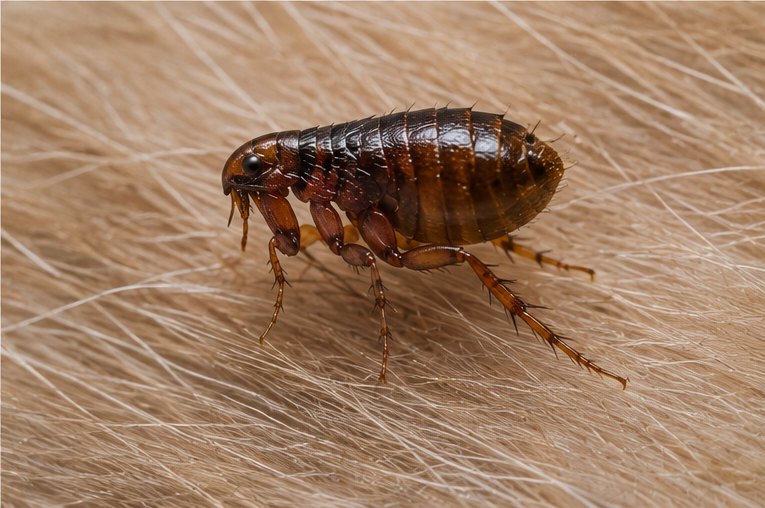
What to look for: small, dark reddish-brown, and flattened side to side rather than top to bottom - which is what lets it move through fur. Wingless. Powerful back legs, and it jumps rather than crawls or flies.
Where: on the pet, in its bedding, and jumping onto passing ankles. Easiest to see against white socks or pale flooring.
What it rules out: anything that flies. Anything flat top to bottom and about the size of an apple pip is a bed bug. Anything hairy and banded is a carpet beetle larva.
What to look for: small dark specks, like coarse pepper, in the pet's coat, in its bedding, and in the carpet where it sleeps. Found reliably by combing the animal over a sheet of white paper.
The confirming test: put the specks on damp white tissue. Flea dirt is digested blood and dissolves into a reddish-brown halo. Ordinary grit does not.
What it tells you: more than seeing an adult, because it stays put and it shows you where the animal actually spends its time - which is where the treatment needs to go.
What to look for: tiny, oval and pearly white. Very small and easily mistaken for dandruff or grit, particularly in bedding.
Where: not on the animal for long. Eggs are laid on the pet and fall off wherever it goes - carpet, sofa, bed, car, shed. That distribution is exactly why the property rather than the animal is what gets treated.
What to look for: small, pale, worm-like and legless, sometimes with a faint darker line visible through the body. Rarely seen because they actively avoid light.
Where: down in the carpet pile, in the gaps between floorboards, along the edges of rooms and under furniture. They move away from light and downward, which is precisely why treatment concentrates on the perimeter and beneath furniture rather than the open floor.
What to look for: honestly, you will not. The cocoon is small, sticky and picks up carpet debris until it is effectively camouflaged. Finding one is unusual.
Why it matters anyway: this is the stage that governs everything about the aftercare. The pupa inside is physically protected and far less affected by treatment than an adult or a larva. It emerges in response to warmth, carbon dioxide and, above all, vibration - the footfall of something walking past.
So the invisible stage is the one that decides whether the treatment works, and it explains an instruction that otherwise makes no sense: keep walking on the treated floors.
What to look for: small, intensely itchy marks concentrated around the ankles and lower legs, often several close together.
What it tells you: the location is the useful part, because fleas reach you from the floor. Bites on skin that was uncovered in bed point elsewhere.
What it rules out: very little on its own. Reactions vary enormously between people and plenty of other things produce similar marks.
Comb over white paper. It is the single most productive five minutes available to you: it finds adults, it finds flea dirt, and the damp tissue test then confirms the flea dirt. Three of the five signs on this page, from one exercise.
Identification of fleas on a pet almost always leads straight to this question, so it is worth being clear about the boundary.
The animal's treatment is a veterinary matter and the vet is the right person to advise on it - what product, what dose, how often, and what suits that particular animal. We do not treat animals and we do not recommend specific veterinary products.
What we can be definite about is the division of labour. The vet's treatment deals with the adults on the animal. Ours deals with the eggs, larvae and pupae in the property, which at any given moment are the great majority of what is present. Neither substitutes for the other, and doing one without the other is why people conclude that whichever one they paid for did not work.
Wash the pet's bedding on the hottest wash the fabric allows as part of the same exercise. That part is free and it removes a reservoir.
Small, dark reddish-brown, wingless, and flattened side to side rather than top to bottom. It jumps rather than crawls or flies, which is the clearest distinguishing feature.
Digested blood, appearing as coarse dark specks in the coat, the bedding and the carpet. Put it on damp white tissue and it dissolves into a reddish-brown halo - ordinary grit stays black.
They actively avoid light and move down into the carpet pile, the gaps between floorboards and the edges of rooms. That is also why treatment concentrates on the perimeter and under furniture rather than the open floor.
The pupal stage, protected inside a sticky cocoon that picks up debris until it is camouflaged. It is far less affected by treatment than the other stages and emerges in response to vibration - which is why you are asked to keep walking on treated floors.
Possibly - they are tiny and they jump, which causes genuine confusion. Springtails are associated with damp rather than animals and they do not bite. The damp tissue test for flea dirt separates the two.
The rest of the fleas advice centre, and the service page it all links back to: Flea Control Greenwich.
Fleas are one of the few pests you can confirm yourself, for nothing, in about ten minutes. Two tests do it - and they also rule the problem out,…
Read the guide →Fleas are the treatment where the instructions afterwards matter as much as the visit itself - and where the correct instructions are the opposite of…
Read the guide →Flea treatment is £180 for the first room and £60 for each additional one - the cheapest additional-room rate we publish. This guide explains why,…
Read the guide →Fleas after a treatment are usually not a failure - they are a stage of the process that nobody explained. Here is how to tell that apart from the…
Read the guide →Tell us what you have seen and where in the property you found it, and we will confirm the service and the price before anything is booked.
£180 for the first room and £60 for each additional room. Call 020 3369 0124, send the enquiry form or message us on WhatsApp.