 Zero Pest
From £180
How to Get Rid of Fleas in a Greenwich Property
Fleas are the treatment where the instructions afterwards matter as much as the visit itself - and where the correct instructions are the opposite of…
Read the guide →Flea Control advice
Fleas are one of the few pests you can confirm yourself, for nothing, in about ten minutes. Two tests do it - and they also rule the problem out, which saves people booking a treatment they do not need.
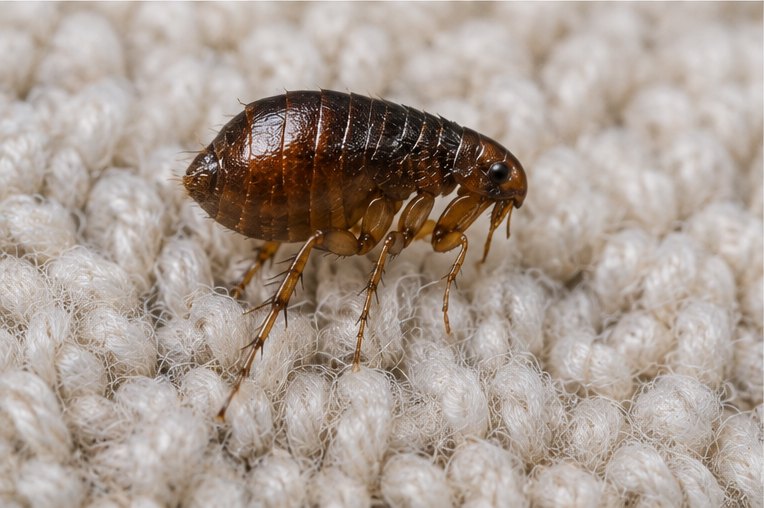
The simplest diagnostic on this whole site, and it costs nothing.
Adult fleas respond to warmth, vibration and carbon dioxide, and they jump towards a passing host. Against pale fabric they are easy to see - small, dark, and moving. If there is an active population in that room, this usually finds it.
It is also useful in reverse. Walking several rooms and finding nothing is a reasonable indication that whatever is biting is not fleas, and worth knowing before you spend anything.
This one confirms flea dirt, which is the most reliable evidence there is - more reliable than seeing an adult, because it stays put.
Flea dirt is digested blood. On damp tissue it dissolves outward into a reddish-brown halo. Ordinary dirt and grit do not - they stay black and stay put. That colour change is a positive result and it is unambiguous.
These two tests together are close to conclusive. Fleas on the socks, or a reddish halo on the tissue, means fleas. Neither, across several rooms and a proper comb of the pet, means the bites are probably something else - and that is worth establishing before booking a treatment.
Useful as a prompt, poor as proof - but the location does say something.
Flea bites concentrate around the ankles and lower legs, because fleas reach you from the floor. Small, intensely itchy, and often several close together. That distribution is genuinely different from bed bug bites, which tend to be on skin that was uncovered in bed.
As with any bite, reactions vary between people, so one person in a household covered and another untouched proves nothing either way.
It happens regularly and it has two usual explanations.
The first is a previous occupant's animal. Flea pupae sit dormant in a protective cocoon and emerge in response to warmth and the vibration of somebody walking past. An empty property provides neither, so they wait - and a new tenant moving in supplies exactly the trigger. Bites within days of moving in are the classic version of this.
The second is wildlife with access to a subfloor, a shed, a garage or the space under a decked area. No household pet required.
If either applies, say so at the enquiry - it tells us which rooms to prioritise, and it is usually a smaller job than people fear.
Bites within days of moving into a new home is one of the most common flea enquiries we take, and it is almost always the same story.
Flea pupae sit dormant in a protective cocoon and emerge in response to warmth and the vibration of somebody walking past. An empty property provides neither, so they wait - through the void period, through the viewings, through the cleaning. The new occupants walking about supply exactly the trigger, all at once.
What that means practically:
Put on pale socks pulled over the ankle and walk slowly around the suspect rooms, especially along the edges and where a pet sleeps. Adult fleas jump towards a passing host and are easy to see against pale fabric. Finding nothing across several rooms is a reasonable indication that it is not fleas.
Put them on damp white tissue. Flea dirt is digested blood and dissolves outward into a reddish-brown halo. Ordinary dirt stays black and stays put. The colour change is unambiguous.
Location. Flea bites concentrate around the ankles and lower legs because fleas reach you from the floor. Bed bug bites tend to be on skin that was uncovered in bed. Neither is conclusive alone, which is why the two tests above are worth doing.
Yes, and it is common. Usually a previous occupant's animal - the pupae stay dormant in an empty property and hatch once somebody is walking about again. Animal access to a subfloor, shed or decked area is the other explanation.
Because most of an infestation is not on the animal. Eggs fall off into the carpet and develop there. The vet deals with the pet; the property needs treating separately, and both are needed.
The rest of the fleas advice centre, and the service page it all links back to: Flea Control Greenwich.
Fleas are the treatment where the instructions afterwards matter as much as the visit itself - and where the correct instructions are the opposite of…
Read the guide →Flea treatment is £180 for the first room and £60 for each additional one - the cheapest additional-room rate we publish. This guide explains why,…
Read the guide →A reference rather than a checklist. All four life stages, every mark they leave, and where each one actually lives - because three of the four are…
Read the guide →Fleas after a treatment are usually not a failure - they are a stage of the process that nobody explained. Here is how to tell that apart from the…
Read the guide →Tell us what you have seen and where in the property you found it, and we will confirm the service and the price before anything is booked.
£180 for the first room and £60 for each additional room. Call 020 3369 0124, send the enquiry form or message us on WhatsApp.