 Zero Pest
From £180
How Do You Know If You Have Fleas in Greenwich?
Fleas are one of the few pests you can confirm yourself, for nothing, in about ten minutes. Two tests do it - and they also rule the problem out,…
Read the guide →Flea Control advice
Fleas after a treatment are usually not a failure - they are a stage of the process that nobody explained. Here is how to tell that apart from the three situations where something genuinely does need to change.
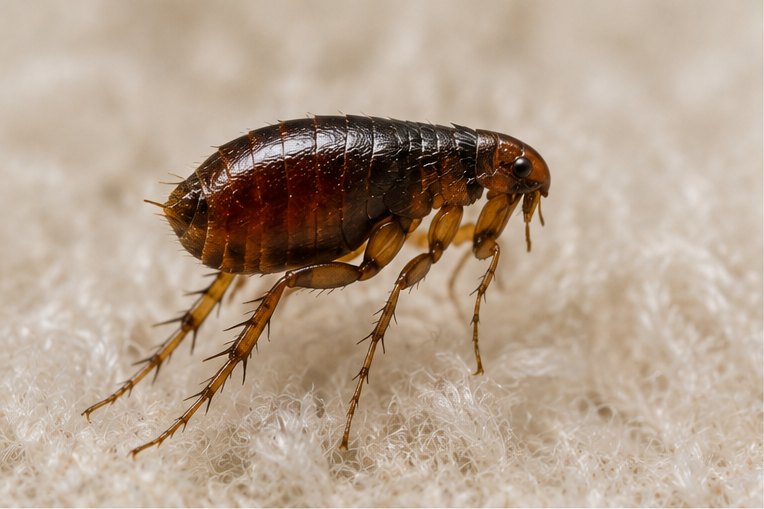
More often than with any other pest on this site, the answer is no.
Flea pupae are protected inside a cocoon and hatch over a period rather than all at once. They emerge in response to warmth and vibration, so they come out as people walk about - which means seeing fleas in the days after a treatment is the expected pattern, not a problem.
The measure is the trend, not the presence. Numbers falling across the two weeks after treatment is a job going correctly. Numbers holding steady or rising after that window is when to make the call.
The unfortunate irony. The instruction that makes the treatment work - keep walking on the floors - is also what makes you see fleas during the fortnight afterwards. People sometimes stop walking on the floors because they are seeing fleas, which is the one response that prolongs it.
The most common genuine cause, and it is almost always well-intentioned.
Vacuuming or mopping treated floors inside the two-week window removes the treatment before the remaining pupae have hatched into it. Every subsequent hatch then arrives on an untreated floor.
It happens most often in three situations: a household that vacuums daily out of habit, a pre-tenancy clean booked before the treatment date was known, and a cleaner who was never told. All three are avoidable with a conversation.
The property treatment deals with what is in the carpet. If the pet is still carrying adults, it re-seeds the floor continuously and no property treatment will outrun that.
Three versions of this:
Veterinary treatment and property treatment in the same week is what closes both halves at once.
Usually somewhere that does not feel like part of the house.
This is why the survey asks where the animal actually goes rather than where it is meant to go. A treated house and an untreated dog bed in the garage is a complete explanation for a problem reappearing a month later.
The landlord and agent version, and it is entirely predictable.
Treated, then empty for weeks. No footfall, so no trigger, so the remaining pupae stay dormant. The new tenant arrives, walks about, and the hatch begins on a floor whose treatment has had weeks to degrade.
The fix is scheduling rather than money: get the floors walked on during the fortnight after treatment, and do not book a clean into that window.
Where a property has been genuinely clear for a month or more and fleas return, it is a new introduction rather than a survival:
The tell is timing. A clear month or more, then a fresh start, points at introduction. Continuous low-level activity from the treatment onwards points at one of the four causes above.
What to tell us if it has come back. How long the clear period was, whether the pet's own treatment is current, whether the floors were cleaned in the first fortnight, and whether the car, shed or garage were included. Those four answers identify the cause almost every time.
A treated property, a treated animal kept on current protection, and floors left alone for the fortnight afterwards will normally clear and stay clear.
What nobody can promise is that an animal that goes to parks and meets other animals will never bring one home again. That is an introduction, not a recurrence, and the honest answer is that keeping the pet's own protection current is what deals with it - not repeated property treatments.
Most flea disappointments come from this fortnight being handled wrongly, so here it is set out plainly.
| When | What to do | What to expect |
|---|---|---|
| Day of treatment | Let the floors dry as instructed | Nothing much |
| Days 1-3 | Walk on the treated floors normally. Do not clean them. | Fleas appearing. This is pupae hatching - it is the process working. |
| Days 4-7 | Same. Still no vacuuming, mopping or wet cleaning. | Numbers should be falling |
| Days 8-14 | Same again. Keep the footfall up. | Occasional fleas, tailing off |
| After day 14 | Resume normal cleaning and vacuum thoroughly | Activity should have stopped |
If numbers are not falling by the end of the second week, that is the point to contact us - and the first three questions will be whether the floors were cleaned, whether every animal's own treatment is current, and whether the car, shed or garage were included.
Almost certainly not. Pupae are protected and hatch over a period, emerging as people walk about. Seeing fleas during the fortnight afterwards is the expected pattern. What matters is whether numbers are falling.
Yes, and it is the most common genuine cause of a poor result. Vacuuming or mopping inside the two-week window removes the treatment before the remaining pupae hatch into it.
Check when it was treated and whether every animal in the household was. Lapsed protection re-seeds the carpet continuously, and no property treatment outruns that.
That timing points at a new introduction rather than survival - the animal picking them up outside, a visiting animal, wildlife access to a subfloor or shed, or second-hand upholstered furniture.
No footfall means no trigger, so the pupae stayed dormant while the treatment aged. The tenant arriving supplied the trigger. Getting the floors walked on during the fortnight after treatment prevents it, and it costs nothing.
The rest of the fleas advice centre, and the service page it all links back to: Flea Control Greenwich.
Fleas are one of the few pests you can confirm yourself, for nothing, in about ten minutes. Two tests do it - and they also rule the problem out,…
Read the guide →Fleas are the treatment where the instructions afterwards matter as much as the visit itself - and where the correct instructions are the opposite of…
Read the guide →Flea treatment is £180 for the first room and £60 for each additional one - the cheapest additional-room rate we publish. This guide explains why,…
Read the guide →A reference rather than a checklist. All four life stages, every mark they leave, and where each one actually lives - because three of the four are…
Read the guide →Tell us what you have seen and where in the property you found it, and we will confirm the service and the price before anything is booked.
£180 for the first room and £60 for each additional room. Call 020 3369 0124, send the enquiry form or message us on WhatsApp.