 Zero Pest
£180 – up to 1 hour
How Do You Know If You Have Rats in Greenwich?
Most people call us at the point where they suspect rats but cannot prove it. This guide is about that gap: what genuinely counts as evidence, what…
Read the guide →Pest Proofing advice
Pest proofing is £180, up to 1 hour. This guide explains what that period of work realistically covers, what it will not fix at any price, and the situations where the honest advice is to use your own builder instead.
| Service | Price |
|---|---|
| Pest proofing | £180, up to 1 hour |
| Materials suitable for the openings found | Included |
| Additional time, if needed | Agreed before it is spent |
Because the amount of work varies more than any other service on this site.
A single pipe entry under a kitchen sink is a few minutes. A ground-floor flat with three open service penetrations, a defective air brick and a kickboard void open to the subfloor is a different proposition entirely. A flat fee that covered both would be overcharging the first customer to subsidise the second.
It is also why proofing is not bundled into the rodent treatment price. Bundling sounds generous and works out the other way round: everybody pays for it, including the people whose problem was one open door on a hot night, and the people who need several hours get whatever fits inside a fee that was never designed for it.
It depends entirely on what the survey found, but as a guide, the following are the routes that most often need closing and are quick to close properly:
The practical approach on the day: we look at what needs closing, tell you what can realistically be done in the time, and start with the routes that are actually being used rather than the ones that are easiest to reach. If more time is needed you are told before it is spent, not afterwards.
Proofing does not mean sealing a building up. Air bricks, vents and underfloor ventilation are there to keep a building dry. Blocking them causes damp, and a damp problem costs considerably more to fix than a mouse problem. Openings get correctly covered, never filled in.
This is the section most companies leave off, and it is the one that decides whether you spend this money well.
In every one of those cases we will tell you what we found and describe it clearly. We would rather lose an hour's work than take money for a repair that was never going to hold.
Quite often, and we will say so.
After a rodent treatment we describe every route we found and what closing it would involve. If you already have a builder, or the work is straightforward and you would rather have it done alongside something else they are doing, that is a perfectly sensible answer. The description we leave you with is written clearly enough for them to quote from.
What we will not do is imply that proofing has to be done by a pest control company. It does not. What matters is that it is done properly, that ventilation is preserved, and that it happens after the treatment rather than before.
Treatment first, proofing second. Always.
Sealing entry points while rodents are still inside leaves them in the building with no way out, which is how a mouse problem becomes a smell in a wall cavity - and that is a considerably more expensive problem than the one you started with, because it usually involves opening up plasterwork to find it.
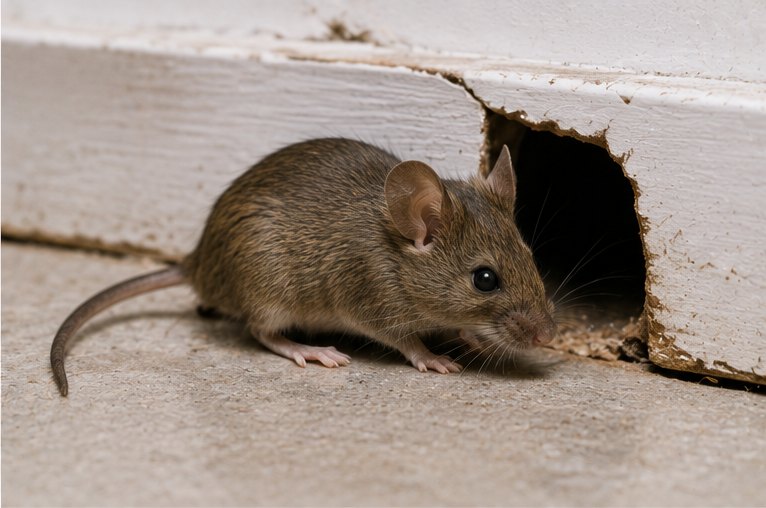
In houses, particularly the interwar and 1930s stock across Eltham and the estate housing further out, rodents are frequently incomers rather than residents. Activity that starts in October in a property that was quiet all summer points at an entry point rather than an established colony.
In that situation, one proofing visit is usually cheaper than a second rodent treatment next autumn - and considerably cheaper than a third the year after. For a landlord with a property that produces the same call every year, it is the obvious spend.
Prices in the abstract are hard to judge, so here is a realistic picture of a typical ground-floor job following a mouse treatment. It is an illustration of the kind of work involved, not a promise about your property - what yours needs is established at the survey.
What was reported rather than done: a gap at the roofline visible from the garden, which is a roofer's job, and a suspect inspection chamber, which is a drainage contractor's. Neither was charged for and neither was patched around.
That last part is the point of the whole exercise. The work that gets done is the work that will hold.
Because the amount needed varies enormously, and bundling it means the customers who need none subsidise the ones who need hours of it. Priced separately, you see the treatment and the repair as two figures and decide on each.
You are told before the extra time is spent, not afterwards. We start with the routes that are actually being used, so the most important work is done first whatever happens.
Yes, and sometimes that is the sensible answer. After a treatment we describe every route we found clearly enough for a builder to quote it. Proofing does not have to be done by a pest control company.
No. Air bricks ventilate the building and blocking them causes damp - a far more expensive problem than the one you are solving. A defective or oversized air brick gets a proper cover fitted so it still ventilates.
After. Sealing entry points while rodents are still inside traps them in the building, which is how a mouse problem becomes a smell in a wall cavity.
Then it is a roofing or drainage repair and we will say so rather than take the money. Proofing is a targeted repair of small openings, not a substitute for building work.
The rest of the pest proofing advice centre, and the service page it all links back to: Pest Proofing Greenwich.
Most people call us at the point where they suspect rats but cannot prove it. This guide is about that gap: what genuinely counts as evidence, what…
Read the guide →Almost everyone tries something before they call, and almost everyone tries the same thing: a trap or a bait point where the droppings were. Here is…
Read the guide →A reference rather than a checklist. Each sign a rat leaves, what it actually looks like, what it tells you, and - just as usefully - what it rules…
Read the guide →Every autumn, in the same house, in the same cupboard. Or a fortnight of quiet after a treatment and then droppings again. Both are common, and they…
Read the guide →Tell us what you have seen and where in the property you found it, and we will confirm the service and the price before anything is booked.
£180, up to 1 hour. Call 020 3369 0124, send the enquiry form or message us on WhatsApp.