 Zero Pest
From £180
How Do You Know If You Have Spiders in Greenwich?
You do not need help knowing you have spiders. Every building in Britain has them. The question worth answering is whether you have a problem - and…
Read the guide →Spider Control advice
Most of what actually reduces spiders in a building costs nothing and has nothing to do with insecticide. Here is the order to do it in, and where treatment genuinely fits.
In order of how much difference they make. If you do these and the problem resolves, you have saved the cost of a treatment - which is a perfectly good outcome from our point of view and we would rather tell you than not.
The single most effective intervention available, and almost nobody does it.
Spiders are where the insects are, and insects are where the light is. Bright external lighting near doors, windows, porches and loading bays pulls flying insects in all night, and the webbing accumulates exactly there.
Reducing what is lit, moving a light away from a doorway, putting it on a sensor rather than leaving it on, or using a warmer light does more for a long-term result than anything we could apply.
A brush or a vacuum with an extension, going into ceiling corners, window reveals, external door surrounds, frame edges, under furniture and along skirtings. Include the egg sacs - a pale rounded silk parcel in or near a web - because leaving them means the population re-establishes from exactly where it was.
Done once, it looks better for a fortnight. Done monthly, it substantially reduces the population, because a spider that has to rebuild constantly in a place with no accumulating catch tends not to stay.
Spiders come in from outside, so the same openings that matter for everything else matter here: gaps under external doors, unsealed gaps around frames, air bricks with broken covers, and openings around service pipes. It will never make a building spider-proof, and it reduces the traffic.
If the three above have been done properly and webbing still returns within days across multiple areas, that is a genuine population and treatment is a reasonable next step. If they have not been done, treatment is being asked to compensate for conditions that are still in place.
We will say so on the phone. Describe what you are seeing, how quickly webbing returns, and what the lighting situation is. If the honest answer is that a treatment would be wasted, that is what you will be told.
Not chasing individual spiders around a room. Two components:
No treatment makes a building permanently spider-free, and anybody telling you otherwise is overselling.
Spiders come in from outside through the same gaps everything else uses, and they will keep doing so. Treatment plus web removal reduces the population that is established. The lighting, the insect supply and the webbing routine are what keep it down afterwards.
That is why, for commercial premises, this is normally a planned programme rather than a one-off - and why for a house it is usually the free measures that matter more than anything we do.
If it is September, you have seen two or three large spiders in a week, and the webbing situation is otherwise normal - nothing needs doing. It is mature males looking for a mate, it happens in every building in the country, and it will stop on its own within weeks.
A glass and a piece of card is the correct treatment, and a towel over the edge of the bath saves you the trouble.
For most houses this is genuinely the answer, and it is worth setting out as a routine rather than as advice, because the difference is doing it consistently.
Fifteen minutes a month. Combined with dealing with the outdoor lighting, it does more than an annual treatment would, and it costs nothing - which is the honest position even though it is not a sales pitch.
Change the outdoor lighting near doors and windows. Spiders follow insects and insects follow light, so reducing what is lit at night does more for a long-term result than any spray.
There is no good evidence for either, and they are recommended constantly. Clearing webs and egg sacs regularly, and dealing with the lighting, actually works.
Yes - and include the egg sacs, which are pale rounded silk parcels in or near the web. Done monthly it substantially reduces a population, because a spider that has to rebuild constantly with no catch tends not to stay.
No, and anyone promising that is overselling. Spiders come in from outside through ordinary gaps. Treatment reduces an established population; lighting, web clearing and closing gaps keep it down.
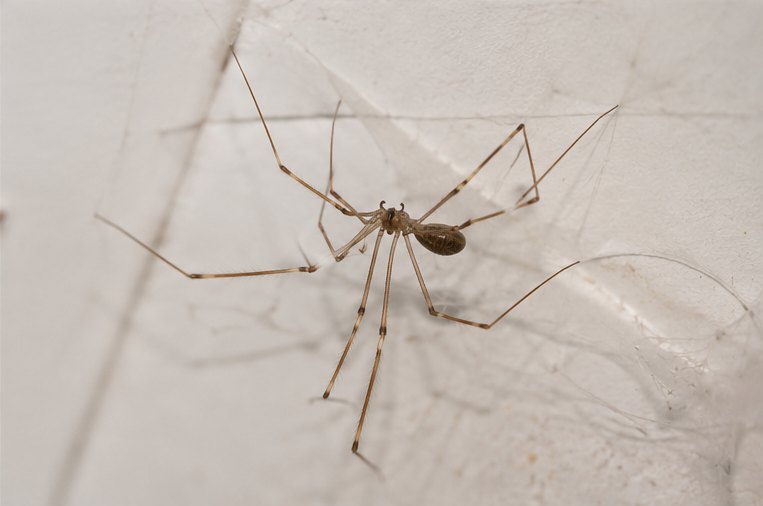
Not necessarily - cellar spiders prey on other spiders, so that corner tangle web is doing some of the work for you.
The rest of the spiders advice centre, and the service page it all links back to: Spider Control Greenwich.
You do not need help knowing you have spiders. Every building in Britain has them. The question worth answering is whether you have a problem - and…
Read the guide →Spider control is £180 for the first area and £60 for each additional one. This is the price guide that tells most of the people reading it not to…
Read the guide →A reference for telling apart the spiders you actually find indoors - and, more usefully, for reading the webs, because the web tells you which…
Read the guide →Spiders return because they live outside and a building is not sealed. That is not a treatment failure, it is the situation - and understanding it is…
Read the guide →Tell us what you have seen and where in the property you found it, and we will confirm the service and the price before anything is booked.
£180 for the first room and £60 for each additional room. Call 020 3369 0124, send the enquiry form or message us on WhatsApp.