 Zero Pest
From £180
How Do You Know If You Have Spiders in Greenwich?
You do not need help knowing you have spiders. Every building in Britain has them. The question worth answering is whether you have a problem - and…
Read the guide →Spider Control advice
A reference for telling apart the spiders you actually find indoors - and, more usefully, for reading the webs, because the web tells you which spider built it without you having to see it.
More practical than trying to identify a spider that has run under the sofa. Three web types cover almost everything found in a British building, and each one identifies its builder.
The house spider. A dense horizontal sheet in a corner, behind furniture, under a cupboard or in a garage, with a tube retreat at one end where the spider waits. This is the web that produces most of the webbing people want cleared, and it is rebuilt readily.
A cellar spider or a false widow. Irregular strands with no obvious pattern, in a ceiling corner, a window reveal or a cellar. The cellar spider's version is very fine and messy; the false widow's is tougher and often has taut anchoring strands running down to a surface.
A garden orb weaver, and almost always outdoors - across a doorway, between plants, over a window. Rebuilt daily. Impressive and irrelevant to anything indoors.
Which matters practically. Sheet webs in the corners of a garage are a house spider population. A wheel-shaped web across the back door is a garden spider doing its job. Only one of those is worth a conversation.
What to look for: large, brown, hairy, long-legged and fast. The one in the bath in September. Builds sheet webs with a funnel retreat in sheds, garages, cellars and the quieter corners of houses.
What it means: nothing worrying. Harmless, and the most common spider in British buildings.
What to look for: very long, extremely thin legs and a small pale body. Hangs upside down in a loose tangle web, usually in a ceiling corner. Vibrates rapidly in its web when disturbed.
What it means: a dry, undisturbed corner. Harmless, and it preys on other spiders, which is worth knowing before clearing them all out.
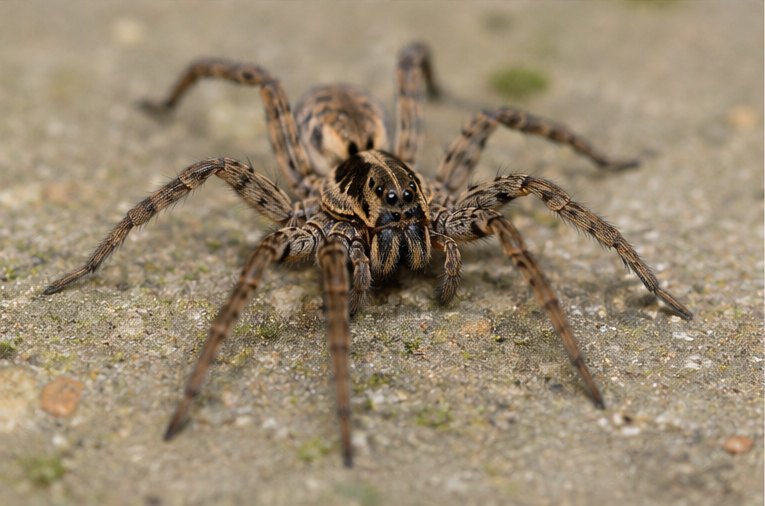
What to look for: medium-sized, brown, patterned, and it does not build a web at all - it hunts across the ground. Usually seen running across a floor. Females sometimes carry an egg sac or young on the back.
What it means: it has wandered in from outside. Harmless, and since it builds no web it contributes nothing to a webbing problem.
What to look for: a glossy, rounded, bulbous body, usually dark brown, sometimes with pale markings on the abdomen. Legs are reddish or orange-brown rather than dark. Builds a tough, untidy tangle web, often in a window reveal, a porch, a shed or a conservatory.
What it means: the one worth identifying properly. It is the British spider most likely to give a bite worth mentioning, though bites are uncommon and usually amount to a local reaction. It is also the most commonly misidentified - a great many photographs sent to us turn out to be house or cellar spiders.
What to look for: a pale, rounded silk parcel attached in or near a web, or carried by the spider. Size and texture vary by species.
What it tells you: that clearing the webs alone will be followed by a fresh generation from the same place. This is why any genuine treatment removes egg sacs as well as webbing - leaving them means the population re-establishes from exactly where it was.
| Where the webbing is | What it usually means |
|---|---|
| Ceiling corners of a lived-in room | Cellar spiders. Ordinary. |
| Garage, shed, cellar or outbuilding | House spiders, in numbers. Normal for those spaces. |
| Window reveals and porches | Worth a closer look - this is false widow habitat. |
| Around external doors and lighting | Following the insects. Change the lighting. |
| Across a high roof structure in a commercial unit | A genuine operational issue |
| Everywhere, returning within days | A population being fed by a large insect supply |
Worth listing, because it removes several worries people arrive with:
Worth including, because a fair proportion of spider enquiries are driven by something somebody read rather than something they saw.
If you have seen something that genuinely does not look like anything on this page, photograph it and send it. That is a reasonable thing to do and we would rather look than have somebody worrying about it.
A house spider's. The sheet is the trap and the tube is where the spider waits. It is the commonest webbing in garages, sheds and the quiet corners of houses.
A cellar spider. Harmless, prefers dry undisturbed corners, and it preys on other spiders - which is worth knowing before you clear them all out.
A glossy, rounded, bulbous body, usually dark brown, with reddish or orange-brown legs and often pale markings on the abdomen. It builds a tough untidy tangle web, frequently in a window reveal or a porch. It is also the most misidentified spider we get sent - a photograph settles it.
Most likely a wolf spider. It hunts rather than building a web, so it has usually wandered in from outside and contributes nothing to a webbing problem.
Yes, if you want the clearing to last. Leaving egg sacs means the population re-establishes from exactly where it was, which is why any real treatment removes them first.
The rest of the spiders advice centre, and the service page it all links back to: Spider Control Greenwich.
You do not need help knowing you have spiders. Every building in Britain has them. The question worth answering is whether you have a problem - and…
Read the guide →Most of what actually reduces spiders in a building costs nothing and has nothing to do with insecticide. Here is the order to do it in, and where…
Read the guide →Spider control is £180 for the first area and £60 for each additional one. This is the price guide that tells most of the people reading it not to…
Read the guide →Spiders return because they live outside and a building is not sealed. That is not a treatment failure, it is the situation - and understanding it is…
Read the guide →Tell us what you have seen and where in the property you found it, and we will confirm the service and the price before anything is booked.
£180 for the first room and £60 for each additional room. Call 020 3369 0124, send the enquiry form or message us on WhatsApp.