 Zero Pest
£90 fixed cost – guaranteed
How to Get Rid of Wasps in a Greenwich Property
A wasp nest is the one job on this site where the main argument against doing it yourself is not that it will not work - it is that most of the…
Read the guide →Wasp Nest Removal advice
Seeing wasps is not the same as having a nest, and a great many people book a treatment for a nest that turns out to be three gardens away. This guide is about telling the difference - and finding yours if you have one.
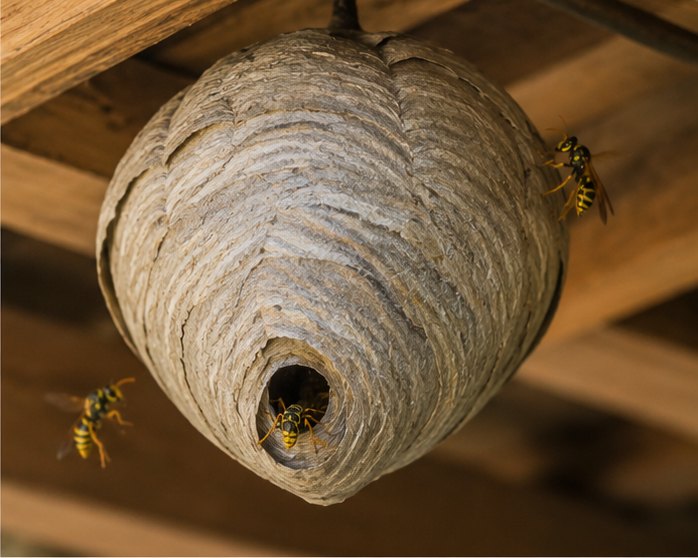
Worker wasps forage a long way from home. A few in the garden on a warm afternoon, wasps around a fallen apple, wasps at a bin or a drink, wasps at the window on the inside - none of that means the nest is on your property, and in late summer it very often means nothing more than that it is late summer.
What indicates a nest is not the number of wasps. It is the pattern.
Stand somewhere safe with a view of the building or the garden and watch for five minutes. You are looking for one thing: a steady two-way stream of wasps going into and out of a single point.
That is a nest entrance, and it is unmistakable once you see it. Wasps arriving from different directions and converging on one spot, disappearing into it, and others emerging and heading off. Not one or two - a continuous traffic, like an airport approach.
If you cannot find a point like that, you probably do not have a nest on your property. Foraging wasps wander; nesting wasps commute.
Watch from a distance and do not investigate up close. A disturbed colony defends itself and wasps can sting repeatedly. Five minutes with binoculars or from an upstairs window tells you what you need. There is no useful reason to stand next to the entrance.
Follow the traffic. Wasps commuting along a fixed line across a garden are going somewhere, and the line points at it. The usual destinations on a domestic property:
This matters because an old nest needs nothing doing and people pay to have them treated every year.
A wasp nest is used for a single season. The colony dies off in autumn and the nest is never reoccupied the following year. So a grey papery nest found in a loft in February, with no wasps around it, is a dead nest. It is not going to wake up in spring. Removing it is optional and cosmetic.
A live nest has traffic. If there is no traffic and it is not summer, it is over.
Worth establishing before you book, because the answer changes what should happen.
If you are not sure, a photograph sent with the enquiry costs nothing and occasionally saves you a treatment you did not need.
It happens regularly, particularly in terraced streets. The traffic line runs across your garden and over the fence, or the entrance turns out to be in the neighbouring roofline.
In that situation treating your property achieves nothing - the nest gets treated where its entrance is, so it needs the cooperation of whoever owns that frontage. Tell us what you have watched and we will explain what we think is happening. It is a common situation and it is usually resolved quickly once the right person is asked.
This changes the priority and it changes the instructions, so it belongs at the top of the enquiry rather than mentioned in passing.
If somebody is stung and has a known allergy, that is a medical matter and needs the appropriate emergency response - not a call to a pest controller.
Not necessarily. Workers forage a long way from home. What indicates a nest is a steady two-way stream going into and out of one specific point - watch for five minutes from a safe distance and you will either see that or you will not.
If there is no traffic and it is not summer, it is a dead nest from a previous season. Wasp nests are used for a single year and are never reoccupied. Removing it is optional.
Yes, and it gets reported as mice regularly. A nest being built and extended inside a cavity or roof void makes a surprising amount of noise. Check for traffic at an opening on the outside of that wall.
Wasps are bright yellow and black, smooth-looking and narrow-waisted. Honey bees are browner and hairier; bumblebees are large, round and very hairy. If it is bees, tell us - a honey bee swarm is a job for a beekeeper rather than a pest controller.
Then that is where the nest is, and it has to be treated at its entrance. Tell us what you have watched and we will explain what is happening - it is common in terraces and usually resolved quickly once the right person is asked.
The rest of the wasps advice centre, and the service page it all links back to: Wasp Nest Removal Greenwich.
A wasp nest is the one job on this site where the main argument against doing it yourself is not that it will not work - it is that most of the…
Read the guide →Wasp nest treatment is £90 - one fixed cost, guaranteed, wherever the nest is on the property. This guide explains what "fixed" actually means here,…
Read the guide →A reference rather than a checklist. Every sign a wasp nest gives away, what a nest looks like at each point in the season, and how to tell a wasp…
Read the guide →A nest in the same roof three summers running feels like a recurring problem. It is not - it is three different colonies choosing the same building,…
Read the guide →Tell us what you have seen and where in the property you found it, and we will confirm the service and the price before anything is booked.
£90 fixed cost, guaranteed. Call 020 3369 0124, send the enquiry form or message us on WhatsApp.