 Zero Pest
£90 fixed cost – guaranteed
How Do You Know If You Have Wasps in Greenwich?
Seeing wasps is not the same as having a nest, and a great many people book a treatment for a nest that turns out to be three gardens away. This…
Read the guide →Wasp Nest Removal advice
A nest in the same roof three summers running feels like a recurring problem. It is not - it is three different colonies choosing the same building, and that distinction is the whole answer.
This is the fact that reframes the entire question, and most people have not been told it.
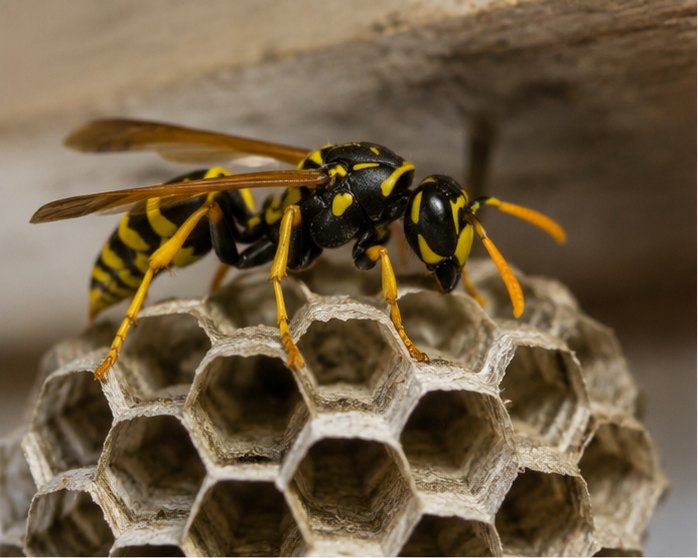
A wasp nest is used for a single season. In autumn the colony dies off. New queens leave, mate, and overwinter somewhere entirely separate - under bark, in a shed, in a loft, in a fold of fabric. The nest they came from is finished and is never reoccupied. Ever.
So if you have had a nest in the same soffit three years running, you have not had a recurring infestation. You have had three unrelated queens independently deciding that particular opening was a good place to start a colony.
They are not coming back. They are choosing, and they are choosing the building.
In spring a queen looks for a dry, sheltered, defensible cavity with a small opening. That is the entire specification, and buildings are extremely good at providing it.
Notice that every one of those is a feature of the building rather than anything to do with the previous nest. That is why treating last year's nest does nothing to prevent this year's, and why an old nest left in a loft is not an attractant.
Usually because it genuinely is more suitable, and the reasons are boring structural ones:
Closing the openings. It is proofing work rather than pest control, it is priced separately at £180, up to 1 hour, and it is the only intervention that affects next year rather than this one.
Two points of timing make the difference between it working and it being a waste:
And the honest limit: where the opening is a rotten soffit, a failed verge or displaced tiles, that is roofing work rather than proofing, and a roofer will quote it. We will describe what we found clearly enough for them to price it.
The exception worth knowing. Wasps at a bin, on fallen fruit or around outdoor food in late summer are foraging workers, and that genuinely is about food. It has nothing to do with whether there is a nest on your property - those wasps may live several gardens away.
Two situations look like recurrence and are not:
A second nest in the same season. Uncommon but it happens, particularly on a property with several suitable sites. Tell us at the booking if you suspect more than one active nest and we will confirm the position before the visit rather than on the doorstep.
The nest is not on your property at all. Wasps commuting across your garden every summer to a nest three houses away will look identical to having your own. The test is the same one as always: is there a steady two-way stream into a single point on your building?
Nobody can promise a wasp-free property, because the wasps you see in August are mostly foraging from elsewhere. What is achievable is a building that a queen does not choose in spring - and that is a proofing job done in winter, not a pest treatment done in summer.
Everything here is done between late autumn and early spring, when no colony is active and before any queen is looking.
One winter of this on a property that has had a nest two or three years running is usually the end of it, and it costs less than the treatments it replaces.
No. A wasp nest is used for a single season and is never reoccupied. A nest in the same soffit three years running is three different queens independently choosing the same opening.
It makes no difference. An old nest does not attract a new queen and will not be reoccupied. Removing it is cosmetic.
Usually structure rather than luck - an older timber roofline with gaps, a warm sheltered elevation, undisturbed roof voids, or simply more outbuildings offering more candidate sites.
Closing the openings a queen would choose. That is proofing work rather than pest control, and the timing matters: after the season so nothing is sealed in, and before spring so it is in place before any queen is looking.
No. Wasps at bins and outdoor food in late summer are foraging workers that may live several gardens away. A queen choosing a nest site in spring is choosing a cavity, not a food supply.
The rest of the wasps advice centre, and the service page it all links back to: Wasp Nest Removal Greenwich.
Seeing wasps is not the same as having a nest, and a great many people book a treatment for a nest that turns out to be three gardens away. This…
Read the guide →A wasp nest is the one job on this site where the main argument against doing it yourself is not that it will not work - it is that most of the…
Read the guide →Wasp nest treatment is £90 - one fixed cost, guaranteed, wherever the nest is on the property. This guide explains what "fixed" actually means here,…
Read the guide →A reference rather than a checklist. Every sign a wasp nest gives away, what a nest looks like at each point in the season, and how to tell a wasp…
Read the guide →Tell us what you have seen and where in the property you found it, and we will confirm the service and the price before anything is booked.
£90 fixed cost, guaranteed. Call 020 3369 0124, send the enquiry form or message us on WhatsApp.