 Zero Pest
£90 fixed cost – guaranteed
How Do You Know If You Have Wasps in Greenwich?
Seeing wasps is not the same as having a nest, and a great many people book a treatment for a nest that turns out to be three gardens away. This…
Read the guide →Wasp Nest Removal advice
A reference rather than a checklist. Every sign a wasp nest gives away, what a nest looks like at each point in the season, and how to tell a wasp from the four things people mistake for one.
What to look for: wasps crossing the same stretch of air repeatedly, in a consistent direction, over several minutes. Not wandering - commuting.
What it tells you: the direction of the nest, which is the single most useful piece of information you can gather. Follow the line to where it converges and you will find the entrance.
What it rules out: wasps moving randomly around a garden, at flowers, at fallen fruit or at a bin are foraging, and foraging tells you nothing about where they live.
What to look for: a steady two-way stream in and out of one specific point - a gap at a soffit, an air brick, a hole in pointing, under a tile, a gap under decking, an opening in a bank of soil.
What it tells you: everything. This is the thing that gets treated, and its location is the only detail that genuinely matters when you book. It is also the reason the price does not change with height - the treatment goes to the entrance wherever it happens to be.
What it rules out: a single wasp entering a gap once is not an entrance. You are looking for continuous traffic.
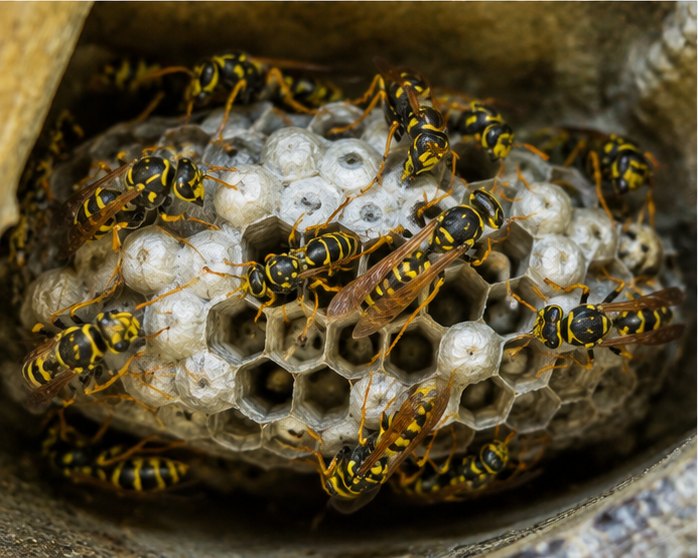
What to look for: a grey or pale brown papery structure with a swirled, layered surface, like coarse marbled paper. In a loft, shed, garage or outbuilding it may be fully visible; in a wall or roof void you will never see it at all.
What it tells you: the size tells you roughly where in the season you are, which is worth knowing because it changes how assertive the colony is:
| Roughly when | What the nest looks like |
|---|---|
| Spring | Golf-ball to tennis-ball sized, built by a single queen |
| Early summer | Growing quickly, a few hundred workers |
| Late summer | At its largest, and the colony at its most assertive |
| Autumn onwards | Colony dying off; the nest is finished |
What it rules out: a nest with no traffic outside summer is a dead nest from a previous season and needs nothing doing. Nests are never reoccupied.
What to look for: scratching, rustling or a papery rasping from inside a wall, ceiling or roof void. Sometimes a low hum in a quiet room with a large nest close by.
What it tells you: that a nest is being built or extended inside the structure. Wasps chew and shape material continuously as the nest grows.
What it rules out: very little on its own - this is reported to us as mice regularly. The way to separate them is to go outside and look for traffic at an opening on that wall.
What to look for: pale patches on a fence panel, a shed, a bench or a garden table, with faint parallel scrapes across the grain, as though the surface has been sanded in narrow strips.
What it tells you: wasps are stripping wood fibre to build with, so there is a nest within foraging range. It does not tell you the nest is on your property.
What to look for: wasps appearing repeatedly in one particular room, especially at a window, and especially if the room is under a roof or against an external wall.
What it tells you: a nest in the roof void or cavity next to that room, with a proportion finding their way through into the living space. One or two wasps indoors across a summer is ordinary; several a day in the same room is not.
A photograph is worth more than a description. Wasp, bee, hornet and hoverfly get confused constantly, and the difference decides whether anything should be treated at all. Send one with the enquiry if you can do it safely.
The three details worth including in an enquiry, because between them they determine how the visit is planned:
Knowing what to check first saves a great deal of standing in the garden.
| Property | Look first at |
|---|---|
| Interwar or 1930s house | Timber soffit and fascia gaps, verge at the gable end, the loft |
| Victorian terrace | Gaps in old pointing, the roof edge, a shared roofline |
| Purpose-built flat | The void behind cladding or panels, above communal entrances, air bricks |
| Converted house | Soffit runs, the roof void, and the boxing around external pipework |
| Property with outbuildings | Shed and garage roof spaces before anything else - they are the easiest sites of all |
| Garden with dense planting | Inside thick hedging, banks of soil, under decking, compost bins |
On a house with a shed and a garage, start there. A colony that had a choice between a roof three storeys up and a shed roof at head height frequently took the shed.
Grey or pale brown, papery, with a swirled layered surface like coarse marbled paper. In a loft or shed you may see the whole thing; in a wall or roof void you will never see it, only the entrance.
Traffic. A live nest has a steady two-way stream at the entrance. No traffic outside summer means a dead nest from a previous season, and those are never reoccupied.
Wasps stripping wood fibre to build with. It means a nest within foraging range, though not necessarily on your property.
Almost always a nest in the roof void or the cavity next to it, with a proportion finding their way through. Several a day in the same room is worth acting on.
Possibly - they are noticeably larger and more brown and orange than yellow and black. They are less aggressive than their reputation, but a nest near a door or a play area is still worth dealing with. Send a photograph if you can.
The rest of the wasps advice centre, and the service page it all links back to: Wasp Nest Removal Greenwich.
Seeing wasps is not the same as having a nest, and a great many people book a treatment for a nest that turns out to be three gardens away. This…
Read the guide →A wasp nest is the one job on this site where the main argument against doing it yourself is not that it will not work - it is that most of the…
Read the guide →Wasp nest treatment is £90 - one fixed cost, guaranteed, wherever the nest is on the property. This guide explains what "fixed" actually means here,…
Read the guide →A nest in the same roof three summers running feels like a recurring problem. It is not - it is three different colonies choosing the same building,…
Read the guide →Tell us what you have seen and where in the property you found it, and we will confirm the service and the price before anything is booked.
£90 fixed cost, guaranteed. Call 020 3369 0124, send the enquiry form or message us on WhatsApp.